





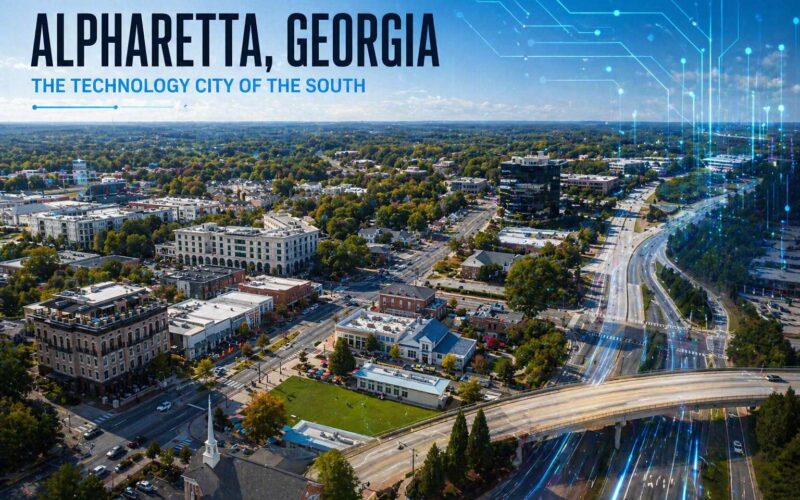
Every weekday morning, roughly 85,000 people commute into a city of 65,000 residents. Most of them are doing tech work.
The city is Alpharetta, home to roughly 900 technology companies and the headquarters or major operating hub of LexisNexis Risk Solutions, Hewlett Packard Enterprise, Equifax, Fiserv, ADP, Siemens, Bakkt, and Morgan Stanley’s wealth-management technology operations — among many others.
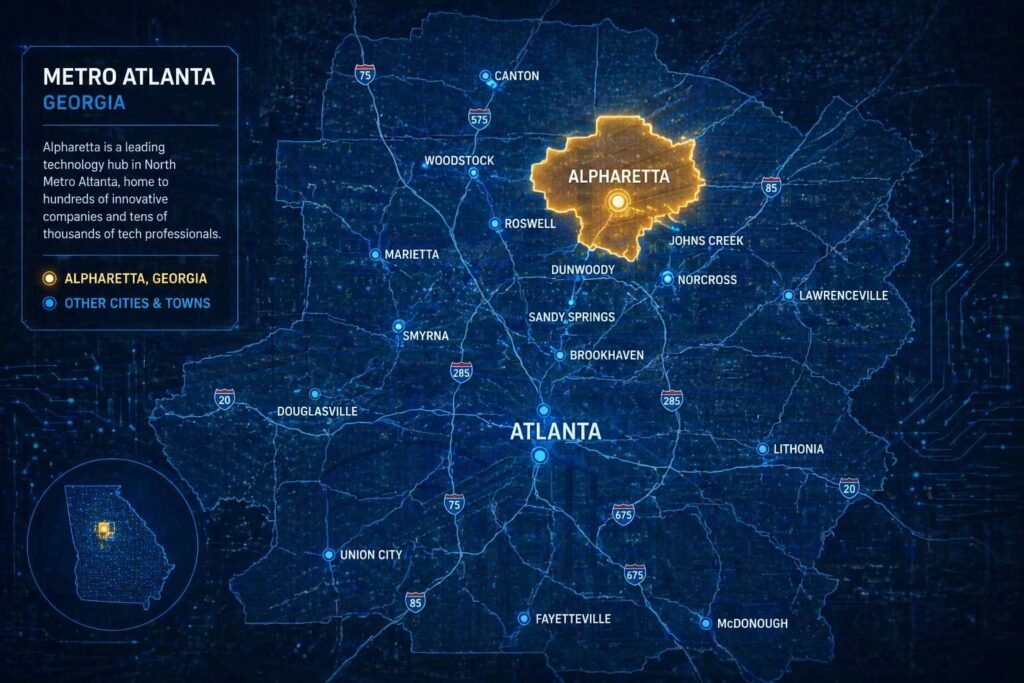
It’s the kind of fact that should redraw your mental map of Atlanta tech. And yet most coverage of “Atlanta tech” still defaults to Midtown’s Tech Square, Buckhead’s Atlanta Tech Village, and the venture-backed startup story along the BeltLine. Those stories are real and important. But the tech employment center of metro Atlanta — measured in jobs, payroll, and Fortune 500 footprint — has been quietly built 25 miles north of downtown, along a stretch of GA-400 that the Georgia legislature formally designated “The Technology Corridor” in 2022.
This is the first in a series of pieces examining the geography of tech across metro Atlanta. We’re starting in Alpharetta because, of all the stories we could tell, it’s the most under-told relative to its actual significance.
A deliberate decision, not an accident
Alpharetta did not become a tech city by drifting into it. The current shape of the city is the residue of a specific set of decisions made by city leadership beginning in 2012, when then-Mayor David Belle Isle and the city council established the Alpharetta Technology Commission — the first organization of its kind in any Georgia municipality. Its stated ambition was to make Alpharetta the “Technology City of the South.”
That branding survived multiple election cycles, several economic cycles, and the kind of leadership transitions that usually scrub away a predecessor’s catchphrase. Belle Isle eventually left office to pursue state-level positions; today’s mayor is Jim Gilvin. The “Technology City of the South” framing is still on the city’s marketing materials. More importantly, the institutional infrastructure built behind it survived, evolved, and recently expanded.
In 2017 the city’s Technology Commission merged with the Greater Alpharetta Tech Network — a parallel effort founded by attorney Karen Cashion — and rebranded as Tech Alpharetta, an independent 501(c)(6) nonprofit. Cashion remained as president and CEO, a role she still holds. Under her leadership, Tech Alpharetta built a tech-focused incubator that today houses dozens of startups, ran an executive thought-leadership programming track, and gradually became the convening organization for Alpharetta’s tech employer base.
On January 28, 2026, the organization rebranded again. Tech Alpharetta is now Tech North Atlanta — a name change that reflects the simple fact that the tech corridor it serves no longer fits inside Alpharetta’s city limits. Cherokee, Forsyth, and Gwinnett counties are now part of its operating footprint. The board chair, Bob Toupin, leads enterprise IT at Impact Climate Technologies. The organization’s strategic advisory board reads like a who’s-who of north-metro tech leadership, and the rebrand was followed quickly by the launch of the inaugural Tech North Atlanta Awards, scheduled for September 16 at TopGolf Alpharetta.
It is unusual for a regional tech ecosystem to have a credible nonprofit orchestrator with this kind of continuity. Most cities try to build one and fail.
Deborah Lanham, the former president and CEO of the Alpharetta Chamber of Commerce who spent another eight years at the Greater North Fulton Chamber before that, traces the corridor’s foundation to a specific set of decisions. “Infrastructure has been a key driver of this growth,” Lanham said. “A fiber-optic grid encased in cement along a stretch of GA-400 between Mansell Road and Windward was brilliant. That decision laid out a welcome mat for data centers, fintech, logistics, and 700-plus other tech-focused companies.” On the convening side, Lanham credits the Chamber’s Tech400 program — which built training and education partnerships with senior leaders across Alpharetta’s tech employers — and former Mayor David Belle Isle’s Alpharetta Tech Commission, which she said brought “key executives and city officials” together for collaborative discussions about the corridor’s direction.
Three pieces of infrastructure — physical, programmatic, and political — and the modern corridor’s foundation comes into focus.
The Fortune 500 anchor tenancy
What drew the companies in the first place is a question with several answers. The honest one: GA-400 access, available office product, lower cost of living for executive families relative to coastal alternatives, business-friendly state policy, and a Department of Economic Development willing to do incentive deals.
What kept them is harder to quantify but easy to demonstrate. Equifax, headquartered in Alpharetta with roughly 2,000 employees and contractors at its 1505 Windward Concourse campus, announced a $25 million expansion in February 2026 that will add roughly 250 jobs and convert 65,000 square feet of former data center space on the third floor of the JV White 1 building into collaborative office space for the company’s Corporate Technology team. Renovations are slated to begin later this year. Fiserv operates a 376,351-square-foot complex at 2900 and 2950 Westside Parkway. LexisNexis Risk Solutions runs its global operations out of 1000 Alderman Drive. Hewlett Packard Enterprise’s Alpharetta campus is on Windward Parkway. Morgan Stanley held a ribbon-cutting in October 2024 on its expanded Alpharetta office, the post-E*TRADE-integration center for a meaningful slice of its wealth-management tech operations. Bakkt, the crypto and fintech firm, remains headquartered at 10000 Avalon Boulevard, though the company has spent the past two years restructuring around a more focused stablecoin-services strategy.
Then there’s the new arrival that may prove the most strategically interesting of the recent wave: in December 2025, EY opened the EY.ai Lab in Alpharetta, a physical-AI and robotics R&D facility built in partnership with NVIDIA. Dr. Youngjun Choi, EY’s newly appointed Global Robotics and Physical AI Leader, is based at the Alpharetta lab. Whatever the next five years of Alpharetta tech look like, applied-AI investment from global firms is going to be a substantial part of the picture.
The corridor’s contractions
Not every Alpharetta tech story over the past decade has been a growth story, and a credible accounting of the corridor has to acknowledge the contractions, too. Hi-Rez Studios, the gaming developer behind Smite and Paladins, illustrates one version of how this can play out. The company was once one of north Fulton’s marquee tech employers, with roughly 500 staff at its leased Brookside Parkway headquarters in Alpharetta. Per public discussion among current and former employees on industry forums, headcount has since fallen to fewer than 40. Hi-Rez moved out of the Brookside Parkway building more than a year ago; the building was subsequently demolished, leaving a vacant lot that anyone driving the corridor can see. The company itself remains operational and continues to list an Alpharetta address — but at a small fraction of its prior physical footprint.
Mavenir, the open-RAN telecom firm with offices on Windward Parkway, illustrates another. The company spent much of 2024 and 2025 in a brutal financial restructuring that included substantial RAN engineering layoffs in the United States and India and the elimination of more than $1.3 billion in debt through a recapitalization. It survived; many of its engineers did not get to.
Both stories are part of the corridor’s actual lived reality, and they are a useful corrective to the boosterism that often accompanies “tech hub” narratives. ATN intends to cover contractions with the same seriousness as expansions, because that is what a daily go-to platform for the people who actually work in this industry looks like.
The corridor effect
None of this would scale without GA-400. In 2022 the Georgia General Assembly formally designated the seven-mile stretch of GA-400 from Haynes Bridge Road to State Route 20 as “The Technology Corridor.” It is, today, the fastest-growing tech corridor in the state, with regional planners projecting an additional 114,000 jobs and 144,000 residents along it by 2050.
North Fulton already hosts more than 40 mission-critical data centers. The corridor is the spine of what regional economic developers call “Transaction Alley” — Georgia firms process roughly 70 percent of all U.S. credit, debit, and gift-card transactions, and a meaningful share of that infrastructure runs through Alpharetta and its neighbors. The North Fulton CID, established in 2003, has spent two decades funding the infrastructure improvements that keep the corridor moving — pedestrian bridges, road redesigns, walkability investments, transit-feasibility work. That last piece will matter increasingly as the corridor adds the next 100,000 jobs.
Why workers actually stay
Two developments deserve particular attention because they answer a question Alpharetta couldn’t answer 15 years ago: where do tech workers actually want to live?
Avalon, the 86-acre, $1 billion mixed-use development at the corner of Old Milton Parkway and GA-400, opened that door. It was the first gigabit-internet community in Georgia, and it serves as the home of Microsoft’s Atlanta-area Sales Office, Customer Center, and Microsoft Technology Center. It is also a place tech workers actually want to spend a Saturday — restaurants, retail, residential, all built to walkable density. Halcyon, the 135-acre development that opened in 2019 just over the line in southern Forsyth County, applied the same playbook to a slightly different audience and connected directly to the Big Creek Greenway.
These developments matter because tech-worker retention is, finally, a lifestyle question. A senior engineer at HPE or LexisNexis or Equifax will eventually decide whether to commute into Alpharetta from a long way away, move closer, or take a remote job for an out-of-market employer. The walkable mixed-use product makes the second option more attractive, and that matters enormously for the long-term scale of the corridor.
Where this leaves us
The story Alpharetta tells about itself is, at this point, well over a decade old. The story metro Atlanta media tells about Atlanta tech still leaves Alpharetta out more often than not. Atlanta Tech News thinks that gap is worth closing, because if we are going to be the daily go-to platform for the people who actually work in this industry, we have to cover where the work actually happens.
In the coming weeks we’ll be publishing more pieces on the north-metro tech story, including a directory of major employers above I-285, a deeper look at Tech North Atlanta’s expansion strategy, and reporting on Curiosity Lab in Peachtree Corners — one of the most significant smart-city testbeds in the country, and another piece of north-metro tech that doesn’t get the coverage it deserves. We’ll also turn south, eventually, to Buckhead, Midtown, and downtown.
If you’re working in north-metro tech and you have a story we should be covering — a hire, a launch, an expansion, a moment that nobody else is going to write about — send us a note. The whole point of Atlanta Tech News is to be the publication that takes that note seriously.
Atlanta Tech News covers the people, companies, and institutions building technology across Metro Atlanta — from Alpharetta to Downtown. Subscribe to our daily newsletter to get our reporting in your inbox every weekday.




1 comment