

Imagine, said Adam Hassan, that 100 people named Claude walked into your company and applied for a job. Every one of them is a genius. Every one of them works at the speed of light. Every one of them will produce exactly what you ask for.
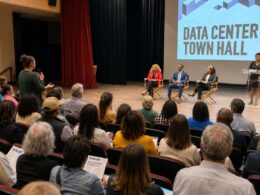
“But you still have to know what to ask them to do,” Hassan, vice president of business development at Perfect Planner, told a packed room at Atlanta Tech Village on April 29. “And that really comes down to whether you understand your field.”
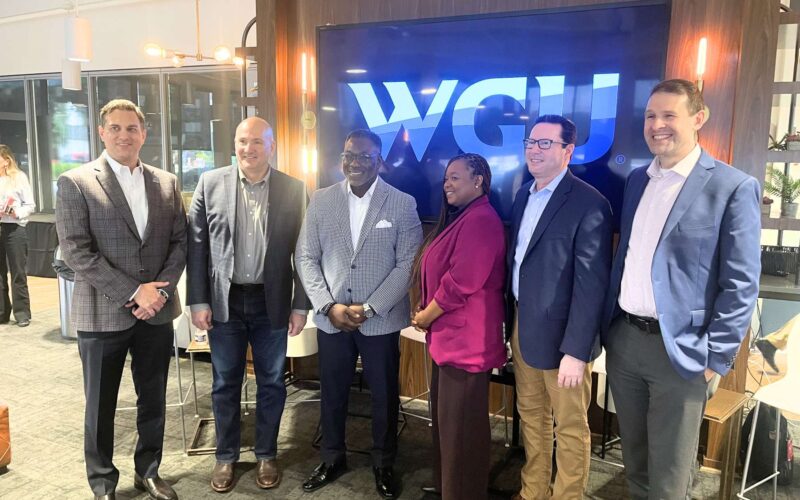
It was a fitting opening salvo for an executive panel that Western Governors University’s School of Technology had convened to take an unflinching look at what AI is doing to work in Atlanta – and what the people building the next workforce say has to change before the bottom rung of the career ladder disappears altogether.
The panel – “Leading Through the Shift: Workforce Strategy in an AI-Accelerated Economy” — was moderated by Paul Varnedoe, principal customer solutions manager at Amazon Web Services and host of the ATL Career Journey podcast. The five panelists came at the question from sharply different angles: state policy, supply-chain technology, strategic advisory, workforce-equity nonprofits, and higher education. They didn’t agree on everything. But on the core diagnosis, they sounded a single note.
AI isn’t just changing how work gets done. It is rearranging which work gets done by humans at all – and the people who get hurt first are the ones who were just trying to get on the ladder.
The broken entryway
Candice Dixon, associate vice president of workforce innovation and impact coalitions at NPower, called it “a broken entryway.” Help-desk roles, junior coordinator jobs, the kind of first positions that taught a young worker how to manage a system, navigate a customer, and absorb the institutional knowledge that turns a kid into a professional – those are exactly the roles AI chatbots and automated workflows are taking first.
“AI is automating certain skills that are traditionally used as entry-level opportunities for people to learn how to work, to learn professionalism, and to really build the institutional knowledge that’s necessary to grow and progress in their careers,” Dixon said.
NPower’s research, conducted with the Burning Glass Institute, mapped 50 entry-level jobs against 500 skills along an automation-and-augmentation curve. The roles Dixon is most worried about aren’t the ones being eliminated outright – they’re the ones whose entry rungs have quietly raised to require two or three years of experience that the candidates can no longer find a way to earn.
“How are we able to get someone two to three years’ experience when we know that the number of entry-level jobs is reducing?” Dixon asked. Her answer was unromantic: apprenticeships, work-based learning, and curriculum co-designed with employers. NPower has built that into its partnerships with AWS, Accenture, and ServiceNow. “Apprenticeships are a tool to provide our talent with the opportunity to make mistakes, to learn on the job, to continue to build professionalism. It gives us the opportunity to validate those skills in real time.”
Representative Todd Jones (R- South Forsyth), who chairs the Georgia House’s Technology and Infrastructure Innovation Committee, gave the room the human picture. He told a story about giving up on interviewing anyone with less than ten years of work experience after a young tech graduate asked, mid-interview, if he could call his mother – then put her on speakerphone.
“We have a resiliency issue,” Jones said. The skills gap, in his telling, isn’t only technical. It’s foundational. “At the end of the day, the human progression is always good to add a staircase to the top and take a staircase off the bottom. That’s been a good progression. But the massive leverage has to come from the fact that you embrace that resilience now is the strategic advantage.”
Re-clustering, not replacement
Dr. Paul LaForge, vice president and dean of WGU’s School of Technology, offered the metaphor that gave this article its name. Picture a pool table, he said. The balls are arranged in their familiar clusters. Then someone hits the cue ball as hard as they can.
“Some are going to be knocked all over the table. Some will drop in the pocket. Some are going to re-cluster in different ways. And that’s what we’re seeing with skills right now as AI is the cue ball,” LaForge said. “Skills are re-clustering. Some are just completely dropping off the table immediately.”
What matters for anyone in higher education or workforce planning, LaForge argued, is reading the table before the cue ball gets there. MIT research he cited suggests the impact depends on whether AI automates a job’s core skill or one of its secondary skills. Automate the core skill and wages tend to fall – but employment can rise as the work becomes more accessible. Automate a secondary skill, and wages rise while employment falls.
The other shift LaForge wanted leaders to internalize is what he called the “AI plus” world: the discipline isn’t standing alone anymore. It’s blending into marketing, finance, supply chain, and engineering.
“If you know marketing, you better know AI,” LaForge said. “But if you know AI and you don’t know the core of marketing, you’re also going to be in trouble.”
And the unglamorous foundation underneath all of it? Data.
“I think of AI as the locomotive revolution. But we don’t have anyone building tracks — and data is the railroad tracks. We need those desperately,” LaForge said.
Durable skills are the new hard skills
If there was a single phrase that united the panel, it was that the soft skills aren’t soft anymore. Hassan put it in numbers.
“IQ is getting cheaper by the second, but emotional quotient — your ability to empathize with someone else — is actually increasing in value by the minute,” Hassan said, paraphrasing a presentation he’d caught the previous week at the University of Georgia’s Home Depot office.
Dr. Adrian K. Haugabrook, senior director for strategy at StrategyForward Advisors and a former executive vice president at Southern New Hampshire University, framed it as a translation problem. The way an employer recognizes a skill, the way an education provider credentials it, and the way a worker actually performs it are three different vocabularies — and the gap between them is widening as AI raises the stakes.
Haugabrook returned repeatedly to a phrase that has become his signature: AI is not a strategy.
“AI is an enabler for better strategy, capability and capacity,” Haugabrook said. “The best technology is one that engages the human experience.”
His checklist for leaders included “data humility” – not just reading what the data says, but asking what questions it raises and what inferences are warranted — alongside human agency, human judgment, and durable skills like critical thinking and adaptability.
Hassan added one more, drawn from his Lean Six Sigma background: don’t lose the voice of the customer to AI fever. “FOMO,” he said — fear of missing out — is what executives now have around AI. “If it doesn’t add value in the eyes of the customer, then we know from Lean Six Sigma it’s waste.”
From organization to ecosystem
No single employer is going to fix this. Neither is any single university or any single agency. That was Haugabrook’s strongest argument of the morning.
What’s emerging in Georgia and elsewhere, he said, is a deliberate stitching-together of policymakers, education providers, and employers — not as a courtesy, but as the only structure that can build pipelines fast enough to keep up. The crucial property of an ecosystem, he added, is that it’s indifferent to geography.
“Ecosystems are agnostic as to whether you’re in an urban environment, rural environment, or suburban environment,” Haugabrook said. The same regional model that works in Buckhead can be stood up in South Georgia, where access to talent and to medical and educational infrastructure runs thinnest.
He also reframed the math state leaders should use to evaluate these arrangements: not just ROI, but “return on objectives.” Are we getting what the state actually said it wanted — competitiveness, mobility, growth — not just a narrow cost calculation?
The state’s bet
Jones, the legislator on the panel, came armed with numbers that should make any Georgian uncomfortable.
“We’re eighth in the union in GDP, 22nd in the world in GDP,” Jones said. “The challenge is the three states right behind us are all growing at double what we are growing.”
The pressure points he laid out weren’t in Atlanta. He has nine Georgia counties without a doctor, 30 without an OB-GYN, more than 60 without a mental-health professional, and roughly 50 of the state’s 180 public school districts that don’t offer physics, chemistry, or math beyond Algebra II. “If you don’t know, you can’t dream,” he said. “Birthplace should not define your access to healthcare or education.”
His pitch is that AI – paired with humanoid and robotic systems and self-service platforms for state services – is the only realistic path to closing those access gaps in his lifetime. But it requires the state to do something Georgia has never quite done before. Jones used the panel to telegraph it.
“We’re going to look at AI as a fundamental horizontal, the same way that we look at electric, wastewater, water, gas, you name it,” Jones said. “So when we look at city creation, county creation, how it is that we’re going to be successful, we know that AI … needs to be part of that equation as a horizontal.”
He framed it as a first-in-the-nation move — a formal designation of AI as core infrastructure, alongside utilities. He also reminded the room that policy alone doesn’t produce outcomes. The state, he said, runs at “five out of ten” on most things. Where it can move the needle is on infrastructure, guardrails, and lifelong-learning support for employers — particularly the 90% of Georgia businesses that, in his words, “aren’t naturally tech.”
Jones offered, with a Gordon Gekko aside, the most contrarian framing of the morning. “To me, AI in an organization is just an opportunity to make more revenue,” he said — pointing to companies on whose boards he serves where the existing tech team is shipping six versions of code a year instead of two, where customer-success teams have moved customers up to premium support tiers, and where in-house counsel is now handling 30 matters at a time instead of ten. The savings, he argued, aren’t the point. The yield is.
What leaders should prioritize in the next 12 months
Varnedoe asked the panel to land the plane: what should leaders actually do in the year ahead?
Haugabrook returned to the trifecta – employers, educators, policymakers – and pushed leaders past the platitude: actually design the ecosystem around a problem you’re trying to solve. Dixon urged leaders not to overlook the people the broken entryway is leaving behind, and to invest in apprenticeship and work-based learning at scale.
LaForge’s prescription was the most operational. Identify one workflow. Build a one-year plan against a three-year picture. Use that workflow as a place to develop two kinds of muscle memory at once: upskilling the workforce, and learning how to live with what he frankly called “promising but brittle” AI technology.
“Let’s do it on a small scale, with gated investment, so that we can earn the right to then start exploring throughout the organization,” LaForge said.
WGU itself put a stake in the ground in the room. LaForge announced the university will open admissions, beginning May 4, to a new Bachelor of Science in AI Engineering — designed, he said, “for individuals who want to build the models, not just use them.” Because the program is online and competency-based, he argued, an AI engineer can now be cultivated in a part of Georgia that doesn’t have a data center, a major employer, or even a hospital.
Which is, in some ways, the whole answer the panel kept circling. AI is the cue ball. The balls have already started moving. The question for Atlanta’s employers, schools, and policymakers isn’t whether the table is going to be reset – it’s whether they’re standing in the right place when the next ball drops.