






On any given weekday, somewhere in the range of 1,300 entrepreneurs walk into a single 103,000-square-foot building on Piedmont Road in Buckhead. The building, Atlanta Tech Village, houses more than 300 startup companies. ATV’s leadership describes it as the fourth-largest tech hub in the United States. We can’t independently verify the ranking methodology behind that claim, but the density it points to is real. There is no other place in Atlanta — and very few other places in the Southeast — where you can run into this many founders in a single hallway.
If Alpharetta’s tech identity is built on Fortune 500 anchor tenants and deliberate municipal infrastructure (the story we told in our foundational piece on Alpharetta), Buckhead’s is built on something different and harder to engineer: founder density. ATV is the gravitational center, and the entire Buckhead startup story radiates out from it.
This is the second piece in our series on the geography of metro Atlanta tech. We’re starting in Buckhead because no honest accounting of “Atlanta tech” can leave it out, and because the story behind the story — one founder’s flywheel — is more interesting than the surface narrative suggests.
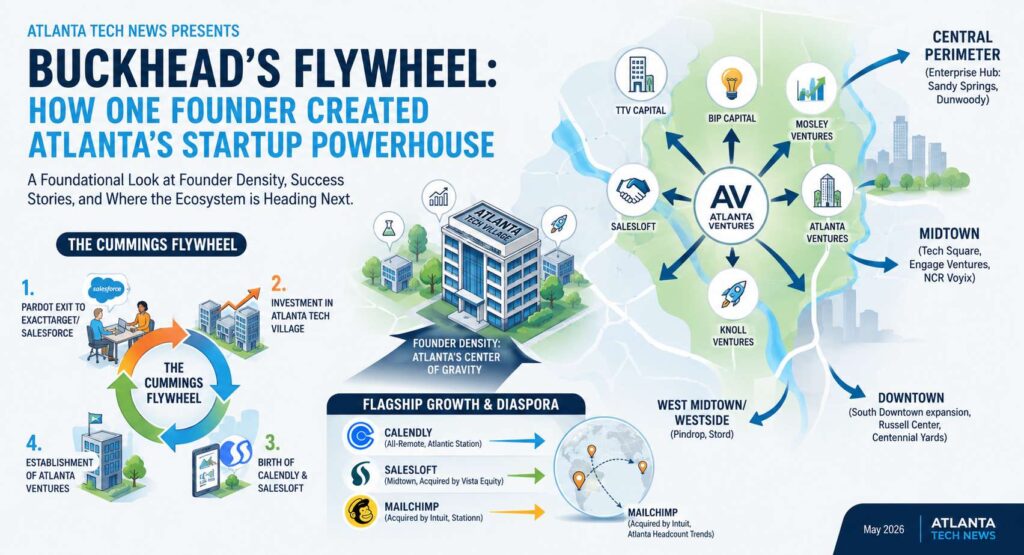
The Cummings flywheel
You can’t tell the Buckhead startup story without telling David Cummings’s story. He’s the founder of Pardot, the marketing-automation company he co-founded in 2007 with Adam Blitzer, bootstrapped to $13.5 million in annual recurring revenue, and sold to ExactTarget for $95.5 million in October 2012. ExactTarget was acquired by Salesforce eight months later for $2.5 billion, which made Pardot part of what is now Salesforce Marketing Cloud.
Cummings could have done what most founders do after a nine-figure exit: leave town, take a board seat or two, and disappear into the financial-advisor circuit. He did not. In 2013 he bought the building at 3423 Piedmont Road, cleaned it out, and opened it as Atlanta Tech Village. The thesis was simple: Atlanta’s startup community lacked a dense physical anchor, and giving founders cheap, flexible space and the chance to bump into each other every day would compound into something the city had never had.
The flywheel that spun up around that decision is now the spine of Buckhead tech.
In 2013, the same year ATV opened, Tope Awotona founded Calendly inside the building. Calendly is now valued at roughly $3 billion. Awotona is a self-made billionaire and was inducted into the Georgia Technology Hall of Fame in March 2025. The same year Calendly was founded, Cummings co-founded Salesloft with Kyle Porter, Tim Dorr, and Rob Forman. Salesloft grew from ATV space into a Midtown headquarters, and in December 2021 was acquired by Vista Equity Partners at a $2.3 billion valuation. In December 2025, Salesloft merged with Clari to form a combined revenue-orchestration platform led by CEO Steve Cox, with Salesloft maintaining roughly 1,150 employees as of February 2026.
Around those flagship outcomes, Cummings built Atlanta Ventures, the early-stage VC firm where he serves as founder and CEO and which has invested in more than 25 Atlanta-area startups. Atlanta Ventures was the lead investor in Calendly’s earliest rounds. Today its portfolio includes Greenzie, an autonomous-mowing-software company headquartered just over the border on Southland Circle, and an active mix of seed and Series A bets across enterprise software, fintech, and applied AI.
ATV itself has institutionalized. Karen Houghton serves as president and CEO, with day-to-day operating responsibility. Jon Birdsong, a venture partner at Atlanta Ventures, leads ATV’s South Downtown expansion — more on that below. Programs include the “It Takes A Village” pre-accelerator for women, Black, and Latinx founders; quarterly Atlanta Startup Village pitch events; and a steady cadence of founder programming.
This is the engine. Buckhead has the density it has because one founder, after one exit, decided to put the proceeds into building the ecosystem he wished had existed when he was starting out.
The flagship companies, then and now
ATV’s two best-known flagship companies — Calendly and Salesloft — are the cleanest illustration of how Buckhead’s ecosystem actually works in 2026: companies are founded in the orbit of ATV, grow up into significant operations, and then, increasingly, leave the neighborhood physically while remaining culturally part of the Buckhead story. Mailchimp, the third name most readers will expect to see in any account of Atlanta software, belongs to a parallel Atlanta story rather than to the ATV one — we treat it separately below.
Calendly, founded inside ATV in 2013, went all-remote in July 2021 and operates today as a globally distributed company. Its listed Atlanta address is 271 17th Street, in the Atlantic Station area technically just outside Buckhead. The company is privately held; valuations beyond the $3 billion Series B mark in January 2021 are not publicly disclosed. Awotona remains CEO. Calendly’s identity is still inseparable from Atlanta and from ATV, even though its operations are no longer concentrated in either.
Salesloft, founded in 2013 with ATV roots, is now headquartered at 1180 West Peachtree Street in Midtown — a few miles south of Piedmont Road but solidly within Atlanta’s office market. Vista Equity Partners has owned the company since 2021. Kyle Porter stepped down as CEO in February 2023 and serves as board chair. The Clari merger announced in December 2025 brings new leadership and an unclear long-term picture for Atlanta headcount; we’ll be tracking it.
Mailchimp belongs to the Atlanta tech story but not, strictly, to the ATV one — and the distinction matters. Mailchimp was founded by Ben Chestnut and Dan Kurzius in 2001, twelve years before Atlanta Tech Village opened, and grew into one of the most successful bootstrapped software companies in American history without ever being part of the ATV ecosystem. It was acquired by Intuit in 2021 for roughly $12 billion. The company remains nominally headquartered in Atlanta. Headcount, however, has materially contracted: Intuit announced layoffs of approximately 1,800 employees globally in July 2024 — Mailchimp’s second mass reduction in less than six months — followed by an additional roughly 8 percent workforce cut in early 2025 as part of a broader restructuring that consolidated 80 technology roles to a smaller set of “growth sites” including Atlanta. The Atlanta footprint is real but is meaningfully smaller than it was at acquisition, and the story of what Mailchimp becomes inside Intuit is still being written. We intend to cover it.
The next layer of operating companies
Below the flagship tier, Buckhead-orbit companies have largely scattered across the city’s other tech-adjacent neighborhoods. Pindrop, the voice-security and deepfake-defense firm, operates out of West Midtown on Howell Mill Road. Greenlight Financial, the family-fintech company, sits on Peachtree Street near downtown. Florence Healthcare, one of the most successful clinical-trial software companies in the country with operations across more than 600 sponsors and 90-plus countries, is in Midtown on Peachtree Street. Stord, the logistics platform, is on Mason Road on the Westside and was actively expanding through 2025 — acquiring Quiet Logistics facilities in Dallas and Shipwire from Ceva Logistics, plus opening a facility expansion in Hebron, Kentucky. OneTrust, the privacy and AI-governance company, relocated its Atlanta headquarters in March 2025 to a 74,000-square-foot building on North Angier Avenue along the BeltLine.
The pattern is consistent. ATV is where founders meet. The companies that emerge end up wherever the right office space, talent pool, or commute geometry lives — which, for tech, is increasingly Midtown, the Westside, and the BeltLine corridor more than Buckhead proper. Buckhead retains the gravitational center, but the orbit has expanded.
The investor ecosystem
Buckhead’s other distinct contribution to the Atlanta tech story is its concentration of venture capital. BIP Capital, founded in 2006 by Mark Buffington, is one of the most consistently top-performing southeastern VCs by DPI and TVPI, with more than 150 multi-stage investments and reportedly more than half achieving 3x or better returns. TTV Capital, founded in 2000, is one of the country’s leading early-stage fintech specialists, with more than 100 portfolio companies and at least eight unicorns, and was named by TechCrunch in 2025 as one of the most important fintech VCs in the United States. Mosley Ventures, founded by Sig Mosley — who has invested in roughly 120 startups since 1990 with 82 liquidity events — has fully deployed its first fund and is in portfolio-support mode. Atlanta Ventures (Cummings’s firm) and Knoll Ventures, a $24 million pre-Series A B2B fund with 23 portfolio companies, round out the active Buckhead-anchored investor set.
There are also, importantly, investors who aren’t in Buckhead but matter to the ecosystem — Engage Ventures, the corporate-venture and innovation platform partnering with Coca-Cola, Home Depot, Delta, Chick-fil-A, UPS, Goldman Sachs, and others, operates from Tech Square in Midtown. We’ll get to Midtown’s story in the next foundational piece.
What didn’t survive
Every regional tech narrative emphasizes the wins. Buckhead’s contraction story is real and worth naming. The Mailchimp-inside-Intuit reduction is the largest visible one — multiple rounds of layoffs from 2023 through early 2025 have meaningfully shrunk the Atlanta operating footprint of one of the most beloved homegrown tech brands. We’re tracking the rebuild Intuit has signaled for 2025–2026 in engineering, product, and customer success.
The broader Buckhead office market reflects the same dynamic. Buckhead’s Class A asking rents remain among the highest in metro Atlanta — historically around $38 per square foot, with more recent reporting in the $34–$35 range — but Midtown has captured a larger share of new tech leasing activity over the past two years, and metro Atlanta sublease availability remains elevated even as it has come down from its 2023 peak. Tech-worker hybrid and remote arrangements (somewhere around two-thirds of the local tech workforce, by recent surveys) continue to mute demand for the kind of large monolithic office space Buckhead specializes in.
These aren’t existential problems for Buckhead’s tech identity. They’re real ones, and the city’s office market is reshaping around them.
The next bet: South Downtown
The most interesting thing about Buckhead’s next chapter may not happen in Buckhead at all. In recent years, Cummings and Birdsong have assembled a 56-building portfolio in South Downtown Atlanta totaling roughly one million square feet. The thesis, which Cummings has discussed extensively on his daily blog at davidcummings.org, is a 40-to-50-year horizon revitalization of the South Downtown neighborhood — residential development at 222 Mitchell Street (the former C&S Bank headquarters, now planned for 220 units), 60 units on Peachtree Street, 40 units on Mitchell Street in a former furniture store, plus an Atlanta Tech Village South Downtown campus that opened to programming in January 2025.
If you take ATV’s original Buckhead bet — that physical density of founders compounds into ecosystem outcomes — and apply it to a much larger, much more disinvested neighborhood, you get something like what’s being built downtown right now. It’s an open question whether the South Downtown thesis works. It’s also one of the most ambitious bets on the future of Atlanta tech anyone is currently making, and Atlanta Tech News will be covering it closely.
Where this leaves us
Buckhead’s tech identity is both well-earned and slightly less concentrated than the simple version of the story suggests. The gravitational center is real and is anchored at 3423 Piedmont Road. The companies that have emerged from that center are, increasingly, not Buckhead companies anymore — they’re Atlanta companies that started in Buckhead and grew up. That’s a feature of a maturing ecosystem, not a bug.
In coming weeks we’ll publish the Midtown foundational piece (Tech Square, Engage Ventures, the corporate innovation centers, NCR Voyix), the Downtown piece (the South Downtown thesis, the Russell Innovation Center for Entrepreneurs, the Centennial Yards story), and a forthcoming feature on Sandy Springs, Dunwoody, and Roswell — the Central Perimeter enterprise hub that is its own meaningful slice of the metro tech story. We’ll also keep tracking the Buckhead diaspora as graduates of the ATV ecosystem continue to define what Atlanta tech looks like.
If you’re working in Buckhead or in the broader ATV-orbit ecosystem and you have a story we should be covering — a hire, a launch, an acquisition, a contraction nobody else is going to write about — send us a note. The point of Atlanta Tech News is to be the publication that takes that note seriously.
Atlanta Tech News covers the people, companies, and institutions building technology across Metro Atlanta — from Alpharetta to Downtown. Subscribe to our daily newsletter to get our reporting in your inbox every weekday.
Correction (May 2026): An earlier version of this article listed Mailchimp among Atlanta Tech Village’s three flagship companies. Mailchimp was founded by Ben Chestnut and Dan Kurzius in 2001 — twelve years before ATV opened in 2013 — and was never part of the ATV ecosystem. The article has been updated to identify Calendly and Salesloft as ATV’s flagship companies and to treat Mailchimp as a parallel Atlanta tech story. Thanks to the reader who flagged it.




1 comment