




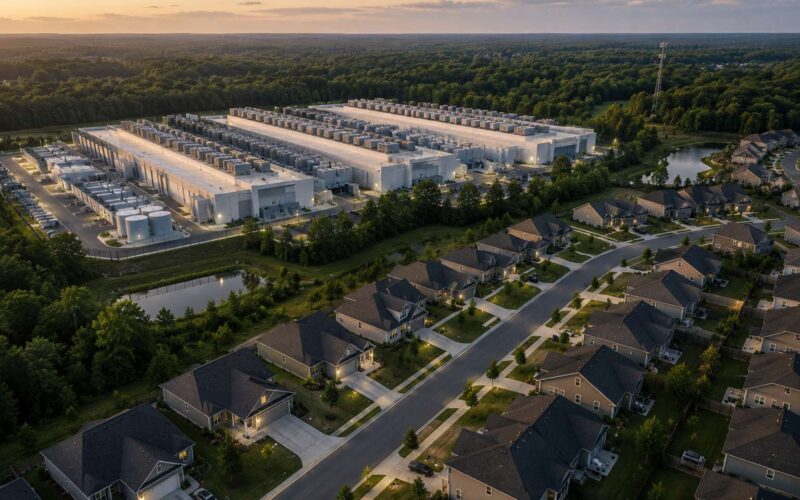
The artificial intelligence boom has a physical address.
It is not only in San Francisco boardrooms, Seattle cloud platforms or research labs building the next generation of AI models. It is in substations, transmission corridors, water systems, industrial parks, county commission meetings and zoning hearings. It is in the giant windowless buildings being built across Metro Atlanta and the Southeast to house the servers that make cloud computing and AI work.
For years, data centers were treated as background infrastructure. Most people used them constantly without thinking about them. Every credit-card transaction, cloud file, business dashboard, online video, route calculation and AI prompt had to be processed somewhere. That “somewhere” was usually out of sight.
That period is over.
Data centers are now one of the defining technology stories in Georgia. They are also one of the most contested.
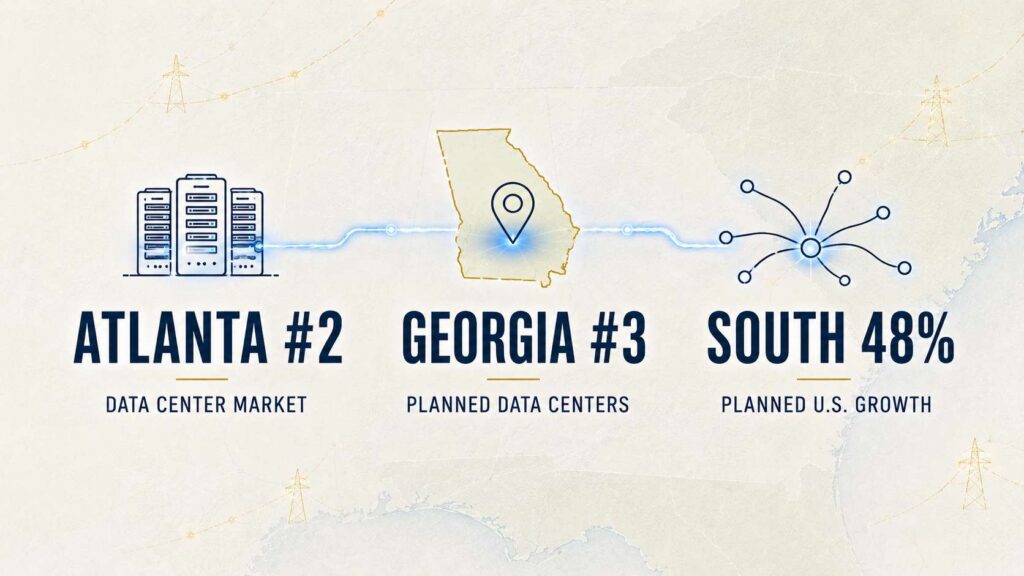
According to CBRE’s March 2026 North America Data Center Trends report, Atlanta ended 2025 with 1,459.2 megawatts of total data center inventory, up 458.8 megawatts from the year before. CBRE said that made Atlanta the second-largest U.S. data center market behind Northern Virginia. The same report put Atlanta’s vacancy rate at just 2% and said the market had 2,076 megawatts under construction.
Those are not normal real estate numbers. They are a sign that Metro Atlanta has moved from a strong regional technology market into the front tier of national digital infrastructure.
The question now is whether Georgia is ready for the consequences.
Why the boom is happening now
Data centers are not new to Georgia. Google began its Douglas County data center presence in 2003 and opened its first Georgia facility in 2007. North Fulton and Alpharetta have long been tied to transaction processing, payments infrastructure and corporate technology operations. Downtown Atlanta and Marietta have colocation facilities that connect enterprises to major cloud platforms.
What changed is scale.
The AI era has made computing power a strategic asset. Large AI models require vast numbers of advanced chips, dense racks, heavy cooling, redundant power systems and fast network connections. Cloud providers and data center developers are racing to secure land and electricity years before some projects are complete.
The geography of that race favors places that can offer several things at once: power, land, fiber, tax incentives, construction labor, low disaster risk and government willingness to approve major industrial projects.
Georgia has many of those ingredients.
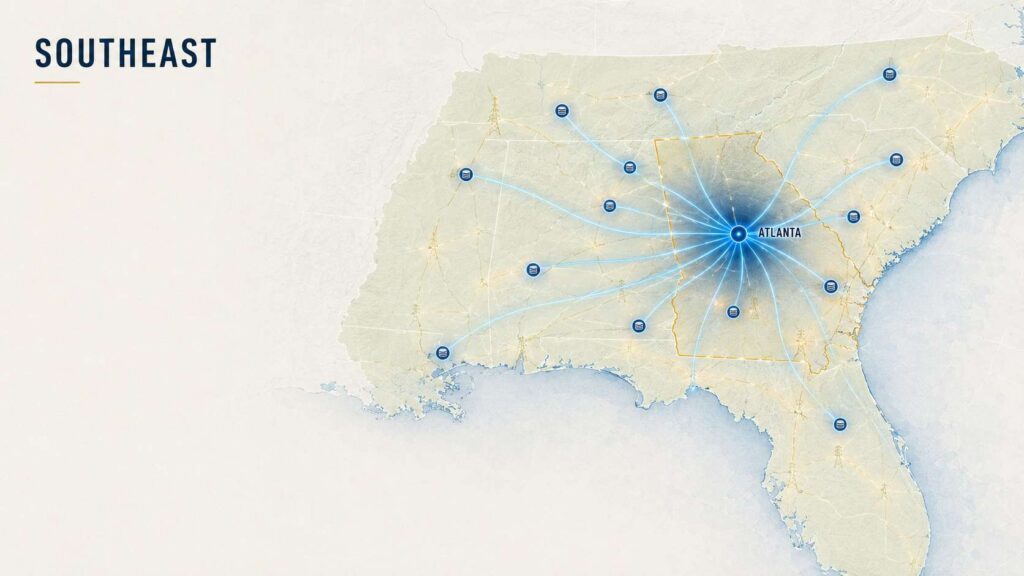
Google says it has committed more than $3 billion of investment in Georgia since building its Douglas County data center. AWS announced plans to invest at least $11 billion in Georgia, with new infrastructure in Butts and Douglas counties expected to create at least 550 high-skilled jobs. Microsoft says it is building Georgia data centers in Douglasville, Palmetto and East Point. T5 Data Centers, an Atlanta-based operator, announced a 91-acre South Fulton/Palmetto campus scalable to 300 megawatts. DC BLOX, Flexential, CoreSite and others are also part of the metro and regional infrastructure map.
Nationally, the shift is just as dramatic. The Pew Research Center reported in April 2026 that 67% of planned U.S. data centers are in rural areas, while most existing data centers are urban. Pew found that the South alone accounts for 48% of planned data centers and that Georgia ranks third nationally in planned data centers, behind only Virginia and Texas.
In other words: the cloud is moving into the counties.
More From This Series


The opportunity
The economic case for data centers is straightforward.
These projects can involve billions of dollars in capital investment. They can expand local tax bases, support construction jobs, create technical operations roles and force upgrades to power, fiber, roads and water infrastructure. In places that have struggled to attract large employers, a single data center campus can look like a generational development win.
The Data Center Coalition, an industry group, argues that the industry produces substantial benefits in Georgia. Its Georgia profile points to billions in economic output and positions data centers as core infrastructure for modern business, health care, education, public safety and entertainment.
There is truth in that framing. Data centers are not speculative office towers. They are the physical layer of the digital economy. Atlanta’s startup community, enterprise employers, universities, hospitals, logistics companies and fintech firms all depend on reliable compute, storage and connectivity. If Georgia wants to be a serious technology state, it cannot ignore the infrastructure behind the software.
The workforce story also matters. Atlanta Technical College has already opened a Microsoft-backed Datacenter Academy lab with Atlanta Technical College Foundation, Microsoft, TA Realty and TA Digital Group support. Microsoft says its Georgia Datacenter Academy work with Atlanta Technical College and West Georgia Technical College served 105 students in 2024-2025. That kind of technical training can create real pathways into operations, networking, cybersecurity, electrical maintenance and energy-management careers.
But the opportunity is not automatic. It depends on the terms of the deal.
The controversy
The controversy starts with power.
Georgia Power says the approved 2025 Integrated Resource Plan projects approximately 8,500 megawatts of electrical load growth over six years. The Georgia Public Service Commission’s March 2026 data center fact sheet says Georgia Power’s projected need grew from 400 megawatts in 2022 to 6,600 megawatts in 2023, then to 8,500 megawatts two years later. In December 2025, the PSC approved an agreement certifying 9,985 megawatts of new energy generation, with roughly 80% expected to power data centers.
That is a massive change in a very short period of time.
The PSC says it has taken steps to protect existing customers, including minimum billing requirements, longer contract terms for large-load customers and a Georgia Power backstop through 2031 if projected contracts do not materialize. Critics argue the state still needs stronger public disclosure and statutory protections so residential and small-business customers are not left paying for infrastructure built around data center demand.
Water is the second flashpoint.
The Metropolitan North Georgia Water Planning District says Metro Atlanta had more than 50 operating data center facilities and more than 40 new proposals under consideration as of summer 2025. The district warns that facilities using evaporative cooling may lose up to 80% of that water to the atmosphere, while closed-loop or near-waterless technologies can significantly reduce consumption. It also notes that Metro Atlanta relies heavily on surface water, sits at the headwaters of six small river systems and has limited groundwater access because of granite bedrock.
The third flashpoint is land use.
Atlanta City Council voted in September 2024 to ban new data centers along and near the Atlanta BeltLine and within a half-mile of MARTA stations, arguing that the city’s urban core should prioritize housing, trails, green space and transit-oriented development. Across Georgia, city and county governments have passed moratoriums or ordinances to slow the pace of approvals, study water and power impacts, and decide where these facilities belong.
The fourth flashpoint is tax policy.
Georgia’s data center sales and use tax exemption was created to attract investment. A December 2025 summary from the Georgia Department of Audits and Accounts and the University of Georgia’s Carl Vinson Institute found that the exemption produced economic activity but also estimated $474.2 million in forgone state tax revenue in fiscal year 2025. The same evaluation concluded that 70% of Georgia data center investment likely would have occurred even without the exemption, because of Georgia’s existing fiber infrastructure, utility reliability and other advantages.
That creates the central public question: are Georgia communities negotiating from strength, or giving away too much to get projects that were likely coming anyway?
This is now a public-contract story
The data center debate is often presented as a fight between economic development and environmental concern. That framing is too narrow.
This is really a public-contract story.
If data centers are going to consume extraordinary amounts of electricity, require specialized water planning, reshape industrial land markets and receive major tax benefits, the public has a right to know what it is getting in return. That does not mean every data center is bad. It does mean the old economic development playbook – announce a large investment, cite a job number, celebrate the ribbon cutting and leave the details to development authorities – is no longer enough.
Georgia needs clearer answers to basic questions.
Who pays for the new generation, transmission and substations required to serve large-load customers? What happens if AI demand slows and projects are delayed or canceled? How much water will each facility use on peak summer days? How many permanent jobs will actually be created? How much tax revenue will flow to local schools and governments after abatements? What standards should apply to backup generators, noise, stormwater, tree loss and proximity to homes?
Those questions are not anti-technology. They are what serious technology coverage now requires.
Atlanta Tech News will examine this issue in a multi-part series covering the data center boom in Metro Atlanta, the policy fight across Georgia, the regional race across the Southeast and what a better public deal for data center growth should look like.
The physical infrastructure of AI is being built now. The public rules for that infrastructure are still being written.
That is the story.
Sources
- CBRE: Atlanta Emerges as One of North America’s Fastest Growing Data Center Hubs
- Pew Research Center: Most new data centers in the U.S. are coming to rural areas
- Georgia Power 2025 Integrated Resource Plan
- Georgia PSC Data Center Fact Sheet
- Metropolitan North Georgia Water Planning District: Data Centers and Water Resources
- Georgia Department of Audits and Accounts: Georgia Data Center Sales and Use Tax Exemption
- Google Douglas County Data Center
- AWS Georgia infrastructure announcement
- Microsoft datacenters in Georgia
- T5 ATL IV announcement
- Data Center Coalition Georgia profile