




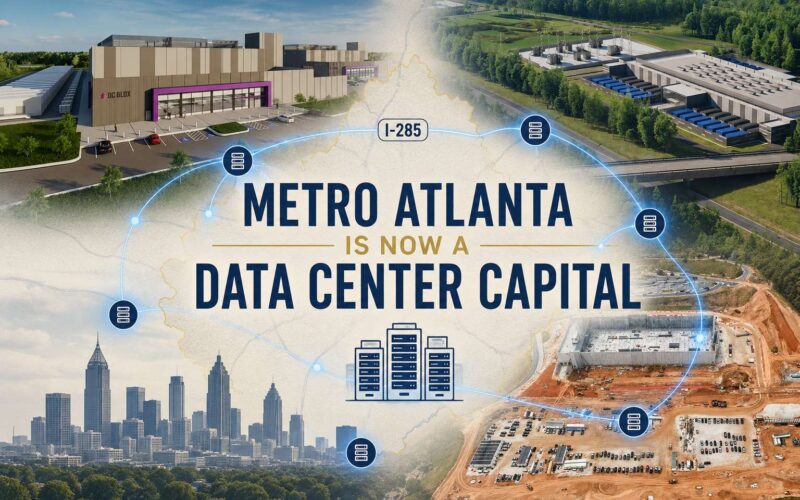
Metro Atlanta’s data center boom is no longer a niche commercial real estate story.
It is a regional growth story. It is a power-grid story. It is a water story. It is a land-use story. It is a workforce story. And in several communities, it has already become a trust story.
The numbers explain why.
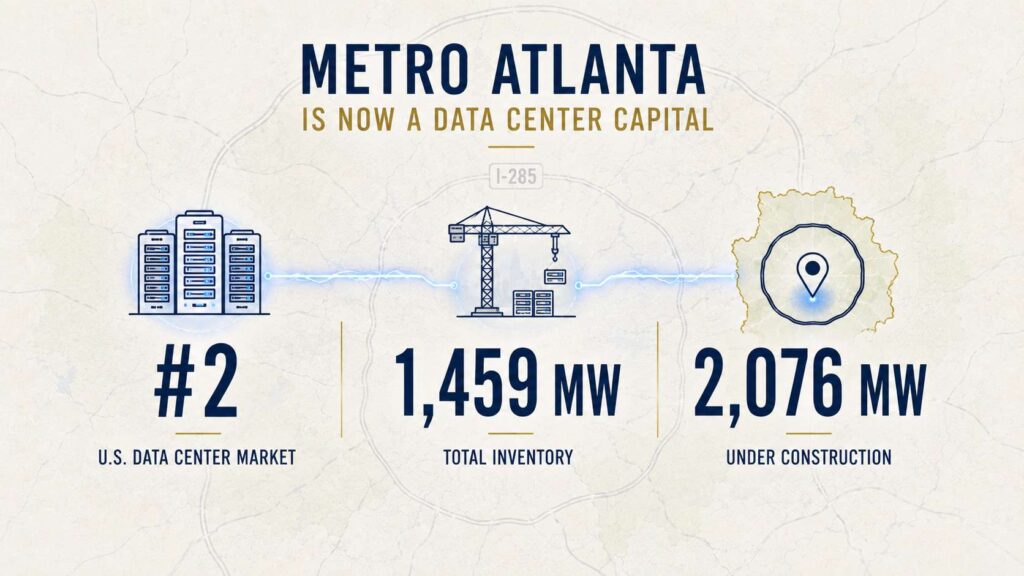
CBRE reported in March 2026 that Atlanta ended 2025 with 1,459.2 megawatts of total data center inventory, up 458.8 megawatts from the previous year. That made Atlanta the second-largest data center market in the country, behind only Northern Virginia. CBRE also reported 2,076 megawatts under construction, a vacancy rate of just 2% and more than 3 gigawatts of long-term power commitments supporting the pipeline.
To put it plainly: Atlanta is no longer chasing the data center industry. The industry is already here.
The challenge is that the region’s rules were not built for this much growth, this fast.
The new geography of Atlanta tech
Atlanta’s first technology map was usually drawn around office corridors: Midtown’s Tech Square, Buckhead’s startup scene, Alpharetta’s enterprise technology base, Sandy Springs and Dunwoody’s corporate arc, and Downtown’s civic and academic assets.
The data center map looks different.
It follows land, fiber and power.
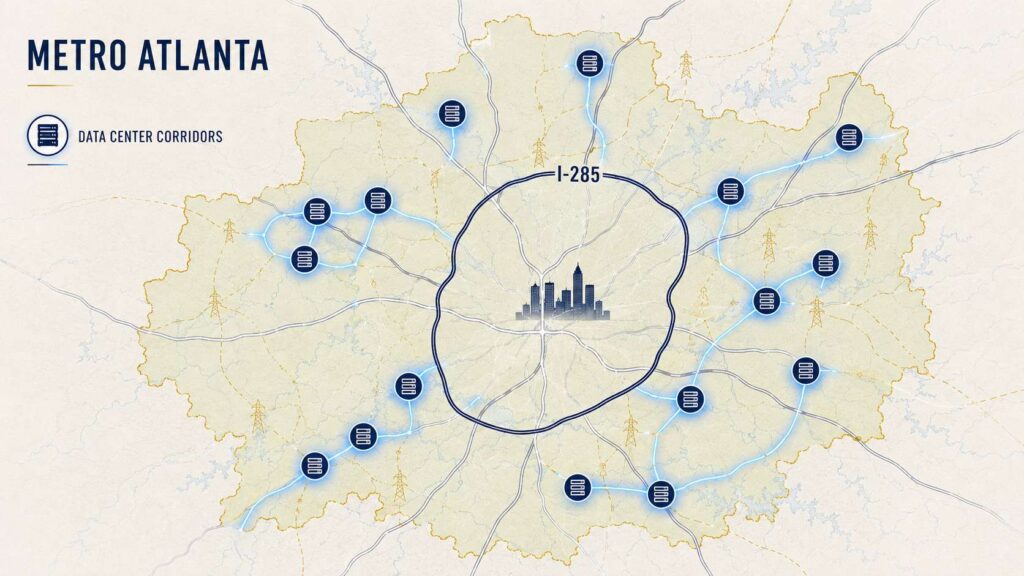
Google’s long-running Douglas County presence dates back to 2003, with the company opening its first Georgia data center facility in 2007 and later using recycled industrial water to cool servers. Microsoft says it is building data centers in Douglasville, Palmetto and East Point. AWS announced plans for at least $11 billion in Georgia infrastructure investment, including Butts and Douglas counties. T5 Data Centers has a Lithia Springs campus marketed at 1 million square feet and 300 megawatts, and in 2024 announced a 91-acre South Fulton/Palmetto campus scalable to 300 megawatts. DC BLOX describes Atlanta-area data center campuses serving west and east metro demand. Flexential lists Atlanta-area facilities in Norcross, Douglasville and Alpharetta. CoreSite operates downtown Atlanta and Marietta colocation facilities that connect customers to major cloud providers.
This is not one project. It is an infrastructure layer spreading across the region.
The Metropolitan North Georgia Water Planning District says Metro Atlanta had more than 50 operating facilities and more than 40 new proposals under consideration as of summer 2025. That is the kind of count that changes how local governments have to think about water, electric service, road access, zoning, emergency planning and long-term land use.
More From This Series


Atlanta’s urban-core line
The first major land-use line was drawn inside the city of Atlanta.
In September 2024, Atlanta City Council voted to ban new data centers along and near the BeltLine and within a half-mile of MARTA stations. The goal was to preserve land around the 22-mile BeltLine loop and transit nodes for housing, mixed-use development, trails, green space and pedestrian-oriented growth.
That ordinance matters because it rejects the idea that data centers are automatically the highest and best use of urban land.
Data centers can generate property value, but they do not produce the street life, housing supply, retail activity or daily foot traffic that cities want around transit and trail corridors. A facility that makes sense in an industrial park may be a poor fit next to a neighborhood or along a public redevelopment corridor.
That distinction is now central to the metro story. The question is not whether data centers should exist. The question is where they belong, under what conditions and with what public obligations.
Fayetteville becomes the trust test
Fayetteville may be the clearest example of how quickly the data center debate can shift from economic development to public trust.
The city has created a Data Center Discussion page to centralize information for residents. According to the city, Fayetteville has one data center campus: QTS Data Centers along Highway 54 West between Veterans Parkway and Tyrone Road. The QTS facility includes 13 buildings totaling approximately 6.2 million square feet.
The scale is enormous. So are the projected benefits. Fayetteville says QTS project estimates forecast $150 million to $200 million annually in real property tax revenue and approximately $170 million in sales tax revenue, along with several hundred ongoing operational jobs plus construction and indirect employment.
But the city has also said no more data centers will be allowed. As of March 5, 2026, new data centers are prohibited in every Fayetteville zoning district.
That tells you something important: even a city pointing to large financial benefits decided it needed to stop additional development.
The controversy around QTS has included public questions about water consumption, construction demand, metering and transparency. Whether every claim made by opponents or supporters holds up is a matter for deeper reporting. But the broader lesson is already clear. When data center projects reach this scale, communities need a single, public, verifiable record of projected water use, actual water use, infrastructure costs, permanent jobs, tax benefits and emergency plans.
If that record is missing, mistrust fills the gap.
Water is not a footnote
Metro Atlanta’s water situation makes the data center debate different here than in many other regions.
The Metropolitan North Georgia Water Planning District warns that Metro Atlanta sits at the headwaters of six small river systems, relies almost entirely on surface water and has limited groundwater access because of granite bedrock. The district also notes that Georgia is prone to drought and drought-like conditions.
Cooling technology is therefore not a technical detail. It is central to whether a project is a good fit.
The water district says evaporative cooling systems may lose up to 80% of the water they use to the atmosphere. It contrasts that with closed-loop or near-waterless cooling technologies that can significantly reduce water consumption. The district also says closed-loop systems can limit water use to less than 100,000 gallons per day compared with evaporative systems that may use as much as 9 million gallons per day.
Those numbers should be part of every local approval conversation.
A data center proposal should not simply say “we use sustainable cooling” and move on. Local governments should know which cooling system is being used, how much water the facility expects to use on normal days and peak summer days, how the facility will operate during drought restrictions, and whether the water utility can serve the project without harming residential or business reliability.
In Metro Atlanta, “what kind of cooling?” is a public-interest question.
The workforce promise
Data centers do create jobs, but not always the kinds or quantities implied by large investment announcements.
Construction can bring a major short-term workforce surge. Permanent operations are typically much smaller. The Georgia Public Broadcasting/Georgia Recorder review of the state tax audit reported that the facilities often employ fewer than 50 workers per center once operational, after much larger construction peaks.
That does not make the jobs meaningless. Data center operations roles can be technical, stable and valuable. The issue is whether the local workforce pipeline is intentional enough to connect nearby residents to those roles.
That is why Atlanta Technical College’s Microsoft Datacenter Academy matters. As ATN previously reported, the academy gives South Atlanta a training facility focused on data center operations, networking, cybersecurity and energy management. Microsoft says its Georgia Datacenter Academy work with Atlanta Technical College and West Georgia Technical College served 105 students in 2024-2025.
For the data center boom to be more than a capital-investment story, workforce commitments have to be public, measurable and local. Otherwise, communities may absorb the power, water and land-use impacts while only a small number of residents get long-term employment benefits.
What Metro Atlanta should ask next
Metro Atlanta is now operating at the scale of a national data center capital. That requires a different level of public scrutiny.
Every major project should answer a basic set of questions before approval.
How much power will it need at full buildout? Who pays for new substations, transmission lines and related infrastructure? How much water will it use on peak days? Will cooling be closed-loop, evaporative, direct evaporative, air-cooled or liquid-cooled? What happens during drought? How many permanent jobs will be created, at what wage range, and how many are expected to be filled locally? What tax incentives or abatements are being used? How much money flows to schools, and when? What happens if the project is delayed or never fully built?
Those questions do not make a community anti-tech. They make it serious.
Metro Atlanta has a real chance to become one of North America’s most important digital infrastructure hubs. It also has a real chance to repeat the familiar mistakes of economic development: overvalue headline investment numbers, undervalue public infrastructure costs, negotiate behind closed doors and discover the tradeoffs after the deal is already done.
The data center boom is here. The region’s next test is whether it can govern the boom as well as it recruited it.
Sources
- CBRE: Atlanta Emerges as One of North America’s Fastest Growing Data Center Hubs
- Metropolitan North Georgia Water Planning District: Data Centers and Water Resources
- Fayetteville Data Center Discussion
- GPB: Atlanta City Council bans data centers along BeltLine
- Google Douglas County Data Center
- AWS Georgia infrastructure announcement
- Microsoft datacenters in Georgia
- T5 Atlanta III
- T5 ATL IV announcement
- DC BLOX Atlanta Data Centers
- Flexential Atlanta Data Centers
- CoreSite Atlanta Data Centers



1 comment