




OpenAI published a report this week saying it had banned a cluster of ChatGPT accounts, likely based in China, for running “covert influence operations” aimed at stoking opposition to data centers in the United States. According to the company, the accounts generated social media comments and images that blamed data centers for rising electricity prices — including a comic strip showing a cigar-chomping businessman holding bags of money while a family reacted in shock to its power bill.
It is a striking story. It is also, by OpenAI’s own account, a campaign that did not work. The company said it found no evidence the operation had any “meaningful” influence on the American debate. Darren Linvill, a Clemson University professor who studies foreign influence campaigns, told Al Jazeera that China’s AI-driven influence work has been “interesting but not effective,” and questioned whether Beijing would even use OpenAI’s tools to do it.
That distinction matters, especially here.
The framing is the real risk
OpenAI is not the only prominent voice suggesting that opposition to data centers is something other than organic. In May, U.S. Interior Secretary Doug Burgum told a policy event that the public’s increasingly negative sentiment toward data center construction was not “organic” and could, in some cases, be linked to “foreign-sourced dark money.”
When senior officials and the country’s most prominent AI company suggest that data center skepticism is foreign-fueled, the implication is hard to miss: the people raising concerns are dupes, or worse. Georgia is the clearest evidence that this framing is wrong.
The questions in Georgia are local, bipartisan and documented
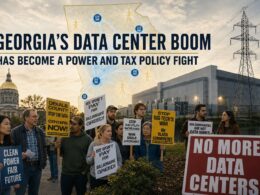
Over the past week, Atlanta Tech News published a five-part series on the data center boom in Metro Atlanta and across Georgia. The concerns we documented did not come from anonymous social media accounts. They came from the public record.
They came from the Georgia Public Service Commission, which certified 9,985 megawatts of new energy generation in December 2025 — roughly 80% of it expected to power data centers — after Georgia Power’s projected load growth jumped from 400 megawatts in 2022 to 8,500 megawatts by 2025.
They came from the Georgia Department of Audits and Accounts, whose December 2025 evaluation estimated $474.2 million in forgone state tax revenue in fiscal 2025 and concluded that roughly 70% of Georgia data center investment likely would have happened even without the state’s tax exemption.
They came from elected officials in both parties. As Georgia Public Broadcasting and the Georgia Recorder reported, Sen. Chuck Hufstetler, a Rome Republican, has pushed legislation to keep data center infrastructure costs out of general utility rates. Rep. Debbie Buckner, a Junction City Democrat, sponsored a bill requiring large facilities to file annual public reports on energy and water use.
And they came from local governments. Atlanta City Council banned new data centers along and near the BeltLine and within a half-mile of MARTA stations in September 2024. Fayetteville prohibited new data centers in every zoning district as of March 2026 — even while citing $150 million to $200 million in projected annual property tax revenue from the QTS campus. Camden County, on the coast, adopted a moratorium in May 2026.
None of that is astroturf. It is a state arguing with itself, in public, about a real and enormous shift.
Real concerns, real numbers
The energy-price worry the alleged Chinese accounts tried to exploit is not invented. It is the central question Georgia regulators have spent two years trying to answer. The PSC says it has built protections — minimum billing requirements, longer contract terms, and a Georgia Power backstop through 2031 — specifically so residential customers are not left paying for infrastructure built for data centers. Those rules exist because the risk is genuine, not because a foreign meme campaign manufactured it.
The water question is equally concrete. The Metropolitan North Georgia Water Planning District counted more than 50 operating data center facilities and more than 40 proposals under review as of summer 2025, in a region that sits at the headwaters of six small river systems and relies almost entirely on surface water. The district warns that evaporative cooling can lose up to 80% of its water to the atmosphere. These are the facts driving Georgia’s debate, and they were on the table long before any ChatGPT account weighed in.
Why this matters for how we cover it
Foreign influence operations online are a real and serious problem, and OpenAI deserves credit for disclosing what it found. Data Center Watch, a project of the AI security firm 10a Labs, counted at least 36 data center projects blocked or delayed between May 2024 and June 2025. Bad actors will try to attach themselves to any live controversy, and AI tools make that cheaper. Linvill’s warning that these campaigns are “getting better with each passing month” is worth taking seriously.
But the lesson of Georgia is that the answer to a foreign influence campaign is not to treat domestic skepticism as suspect. It is to keep the debate anchored in verifiable local facts: megawatts, gallons, tax dollars, permanent jobs, and who pays when a project is delayed or canceled.
As we wrote earlier this week, Georgia’s task is not to reject data centers. It is to stop negotiating from a position of awe — and to demand a public record clear enough that no one, foreign or domestic, can fill the gap with a cartoon. That record is the best defense against manipulation. A community that can see the real numbers does not need a meme to tell it what to think. And it should never be told that its legitimate questions belong to someone else.
Sources
• Al Jazeera: OpenAI says China-based actors stoking opposition to AI data centres
• Atlanta Tech News: The Server Boom Comes South
• Atlanta Tech News: Metro Atlanta Is Now a Data Center Capital
• Atlanta Tech News: Georgia’s Data Center Boom Has Become a Power and Tax Policy Fight
• Atlanta Tech News: The Southeast Is Becoming the Data Center Belt of the AI Era
• Atlanta Tech News: What Should Georgia Require From a Good Data Center Deal?