




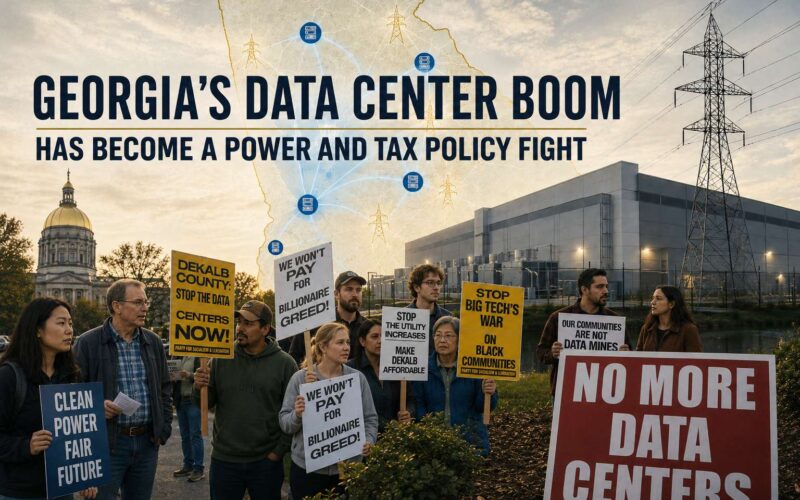
The biggest data center debate in Georgia is not about buildings.
It is about who pays.
Over the past two years, the state has moved from celebrating data centers as high-value economic development projects to confronting a harder question: can Georgia absorb the power, water and tax consequences of the boom without shifting too much risk onto residents?
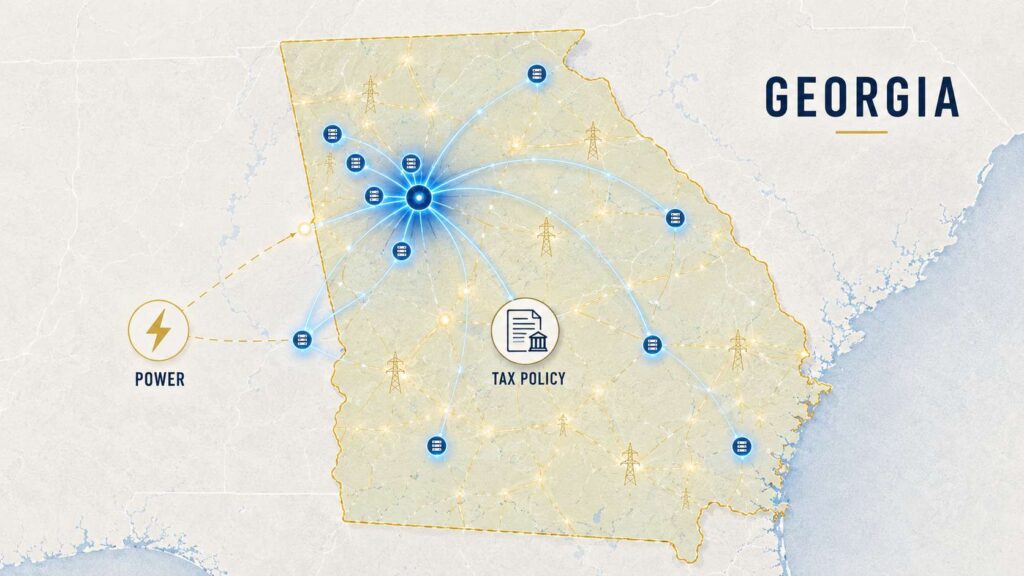
That question now runs through the Georgia Public Service Commission, Georgia Power’s long-range energy planning, county development authorities, city zoning departments, the state tax code and the General Assembly.
The data center industry argues that it is bringing critical infrastructure, private capital, technical jobs and a larger tax base to Georgia. Critics argue that the state is moving too quickly, giving away too much in tax benefits, and relying on electric-load forecasts that could leave customers exposed if AI demand changes.
Both sides agree on one thing: the scale is new.
The power forecast changed fast
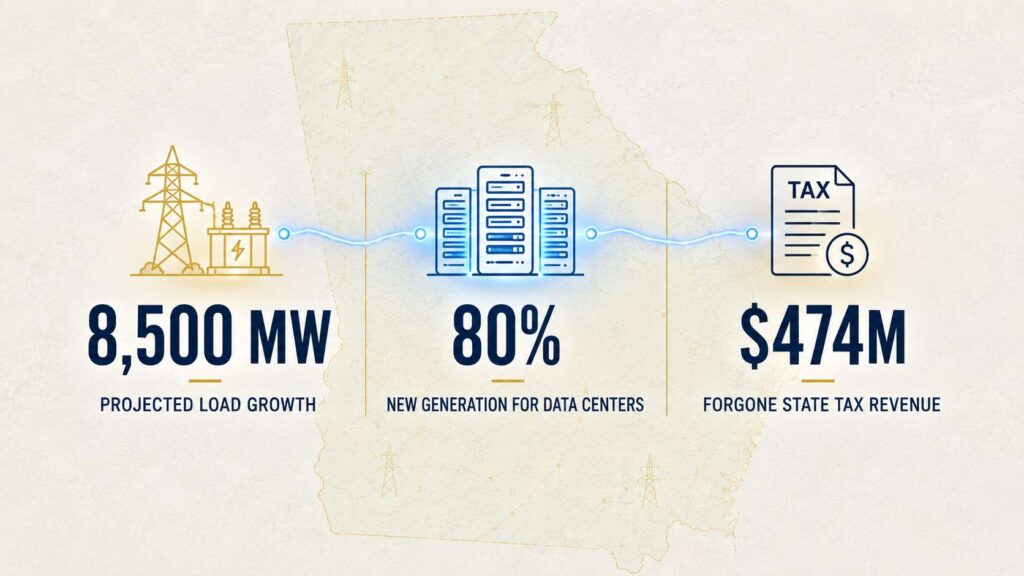
Georgia Power’s approved 2025 Integrated Resource Plan says the company projects approximately 8,500 megawatts of electrical load growth over six years. That is an increase of approximately 2,600 megawatts compared with projections in the 2023 IRP Update.
The Georgia Public Service Commission’s March 2026 data center fact sheet shows how quickly the forecast moved. In 2022, Georgia Power estimated it would need to increase generation by only 400 megawatts over the next seven years. By 2023, with data centers proliferating, that estimate grew to 6,600 megawatts. Two years later, it grew to 8,500 megawatts.
Then came another jump.
On Dec. 19, 2025, the PSC approved an agreement between its Public Interest Advocacy Staff and Georgia Power certifying 9,985 megawatts of new energy generation. The PSC says approximately 80% of that new generation is expected to power data centers.
That means the physical demands of the AI and cloud economy are now embedded in Georgia’s energy future.
The PSC says it is protecting ratepayers
The commission has tried to answer the most politically dangerous question: will ordinary customers pay for infrastructure built to serve data centers?
The PSC says no.
Its fact sheet points to several protections. In April 2024, the commission ordered Georgia Power to ensure revenue from data centers would reduce, not increase, residential bills; file quarterly reports tracking new data centers; and provide cost-allocation studies. In January 2025, the PSC approved a rule allowing minimum billing requirements and longer contract terms for new large-load customers, designed to make sure data centers keep paying for new infrastructure even if they leave the state. In April 2025, the PSC approved changes to Georgia Power’s rate structures for large-load customers such as data centers.
The PSC also says Georgia Power agreed to financially backstop costs associated with new energy production through 2031 if expected data center contracts do not materialize.
That is the commission’s case: the boom is real, the power is needed, and the rules have been adjusted so data centers pay their way.
But the argument has not ended.
More From This Series


Critics want stronger disclosure and law
Some lawmakers and public-interest advocates do not believe PSC rules are enough.
Georgia Public Broadcasting and Georgia Recorder reported in January 2026 that lawmakers were considering multiple bills tied to ratepayer protection, public disclosure and the data center tax exemption. Sen. Chuck Hufstetler, a Rome Republican, renewed his push for legislation aimed at keeping data center infrastructure costs out of general rates. Rep. Debbie Buckner, a Junction City Democrat, sponsored a bill that would require large facilities to submit annual public reports on energy and water usage.
The disclosure fight matters because data center development often happens through confidential site-selection and utility negotiations. Companies argue that confidentiality is necessary to protect competitive information and security. Local governments and residents often find out late in the process that a project may require large amounts of electricity, water, transmission infrastructure or backup generation.
That creates a public blind spot.
If Georgia wants to grow as a data center state, it needs a way to protect legitimate company information while still giving communities enough data to understand what is being approved. Power and water demand are not minor private details when public infrastructure has to be built around them.
The tax break is now under scrutiny
Georgia’s data center sales and use tax exemption was enacted in 2018 to attract data center investment. It exempts qualifying purchases tied to data center construction and equipment, with qualification thresholds based on investment and job creation.
The policy has helped Georgia compete. But a 2025 evaluation has complicated the case for keeping it unchanged.
A December 2025 Georgia Department of Audits and Accounts summary of work by the University of Georgia’s Carl Vinson Institute found estimated forgone state tax revenue of $474.2 million in fiscal year 2025. The summary said the exemption did generate economic activity, but also concluded that only 30% of Georgia data centers could be attributed to the tax exemption – meaning 70% likely would have existed in the state without it.
That finding goes to the heart of the debate.
Incentives are easiest to defend when they make the difference between winning and losing a project. They are harder to defend when most of the investment would have arrived anyway because of power infrastructure, fiber, low natural disaster risk, available land and the strategic importance of the Atlanta market.
The same evaluation found that modifying what is exempted or requiring more investment in activities with in-state impact would improve the exemption’s return on investment.
That is a practical reform path. Georgia does not have to choose between “tax breaks forever” and “no data centers.” It can ask whether the incentive is calibrated to today’s market rather than the market of 2018.
Local governments are writing their own rules
While the state debates power and tax policy, local governments are rewriting zoning codes.
GPB reported in October 2025 that a wave of Georgia counties and cities had passed moratoriums or ordinances tied to data centers. The concerns included water use, energy demand, noise, health and safety, and the basic fact that many local codes never defined data centers as a land-use category.
The local responses vary. Some jurisdictions are adding buffers, noise standards or special-use requirements. Some are limiting water use. Some are temporarily pausing approvals while they update codes. Atlanta barred new data centers along and near the BeltLine and within a half-mile of MARTA stations. Fayetteville prohibited new data centers in every zoning district after the QTS campus became a major public issue. Camden County, on the coast, adopted a six-month moratorium in May 2026 amid concern over possible data center rezoning.
This is not a left-right issue. Skepticism is coming from urban council members, rural commissioners, environmental groups, consumer advocates and lawmakers in both parties.
The reason is simple: data centers are too large to treat as routine industrial buildings.
The state needs a better bargain
Georgia has real advantages in the data center economy. It has Atlanta’s network and enterprise base, strong logistics, major fiber routes, large developable sites, a growing technical workforce and a state government that knows how to recruit large projects.
But those advantages mean Georgia has leverage.
The state does not need to approve every project on whatever terms a developer requests. It can require large-load customers to pay for the infrastructure they need. It can require public reporting on water and energy use above a reasonable threshold. It can require local drought plans and emergency plans before approval. It can adjust incentives to reward projects that use less water, create more local jobs, invest in workforce training or locate in communities that actually want them.
Most importantly, Georgia can stop treating data center policy as a series of one-off deals.
This is now a statewide infrastructure strategy. It deserves statewide standards.
The opportunity is large. So is the risk. Georgia’s task is not to reject data centers. It is to stop negotiating from a position of awe.
Sources
- Georgia Power 2025 Integrated Resource Plan
- Georgia PSC Data Center Fact Sheet
- Georgia Department of Audits and Accounts: Georgia Data Center Sales and Use Tax Exemption
- Georgia Department of Revenue: Data Centers Sales and Use Tax Exemption Aggregate Expenditures by County
- GPB: Outrage over surge of data centers in Georgia inspires wave of bipartisan bills
- GPB: A wave of data center ordinances sweep through Georgia counties
- GPB: Camden becomes first county on the coast to adopt data center moratorium




1 comment