





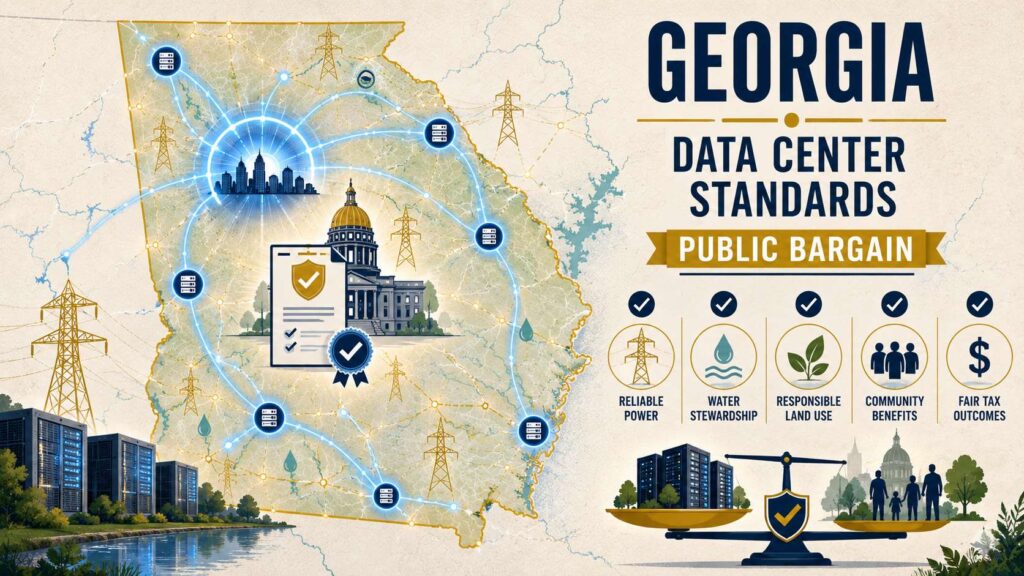
Georgia does not need a data center panic.
It needs a data center standard.
The state is already one of the country’s most important data center markets. Atlanta is now the second-largest U.S. data center market behind Northern Virginia, according to CBRE. Georgia ranks third nationally in planned data centers, according to Pew Research Center. Georgia Power is planning around thousands of megawatts of new electrical load, much of it tied to data centers. City and county governments are writing moratoriums and ordinances almost in real time.
The question is no longer whether data centers are coming.
They are here.
The real question is what Georgia communities should require before saying yes to the next wave.
Start with transparency
The first requirement should be basic public transparency.
A large data center is not a normal warehouse. It can require extraordinary amounts of electricity, specialized cooling, backup generation, security, fiber routes, stormwater planning and road access. It can change land-use patterns and require utility upgrades that outlive the original project.
Yet many projects arrive through confidential economic development processes. Some confidentiality is understandable. Companies have legitimate security and competitive concerns. But confidentiality cannot become a shield against public understanding.
Communities should have access to non-confidential summaries of expected power demand, water demand, cooling technology, backup generation, construction timeline, permanent jobs, tax incentives and infrastructure obligations.
Residents do not need server specifications. They do need to know whether their water system, power system and tax base are being reshaped.
Make large-load customers pay their way
The biggest public fear is simple: will households and small businesses end up paying for infrastructure built for data centers?
The Georgia Public Service Commission says it has taken steps to prevent that. Its March 2026 data center fact sheet says Georgia Power must use minimum billing requirements, longer contract terms and other protections for new large-load customers. The PSC also says Georgia Power agreed to backstop costs for new energy production through 2031 if expected data center contracts do not materialize.
Those protections matter. But they should be treated as a floor, not the ceiling.
Data centers should pay the full cost of generation, transmission, substations and other infrastructure specifically required to serve them. If a project is canceled, downsized or delayed after infrastructure is built, the public should not be left holding the cost. If a developer benefits from fast-tracked power, the terms should be clear enough for regulators and the public to understand who carries the risk.
The principle is straightforward: growth should not be subsidized through surprise.
Put water technology in the approval process
Metro Atlanta cannot treat water as an afterthought.
The Metropolitan North Georgia Water Planning District says the region relies heavily on surface water, has limited groundwater access and sits at the headwaters of six small river systems. The district also says evaporative cooling may lose up to 80% of water to the atmosphere, while closed-loop or near-waterless cooling can significantly reduce consumption.
That means local approvals should require clear answers on cooling technology.
A data center proposal should identify whether it will use closed-loop cooling, evaporative cooling, direct evaporative cooling, air-cooled chillers, liquid cooling or a hybrid approach. It should disclose estimated normal-day and peak-day water use. It should explain how the facility will operate during drought restrictions or emergency outages. It should identify whether new water or wastewater infrastructure is required and who pays for it.
Georgia should not use the same standard for a near-waterless facility and a highly water-intensive facility. The approval process should reward lower-consumption designs, especially in water-sensitive areas.
Protect the right land for the right uses
Data centers belong somewhere. They do not belong everywhere.
Atlanta City Council recognized that distinction when it banned new data centers along and near the BeltLine and within a half-mile of MARTA stations. The city was not rejecting the digital economy. It was saying that land near trails and transit should prioritize housing, mixed-use activity, public space and human-scale development.
That should be the model: decide what land is for before the data center proposal arrives.
Industrial land with strong power access and limited neighborhood conflict may be appropriate. Transit-oriented development zones, affordable housing corridors, fragile watersheds and residential edges may not be. Local governments should establish clear zoning categories, buffers, design standards, noise limits, lighting rules, tree protections, stormwater requirements and generator standards before they are under pressure from a specific project.
The worst time to write policy is after a billion-dollar prospect is already in the room.
Do not confuse construction jobs with permanent jobs
Data centers can produce large construction employment. That is real work and it matters.
But the permanent workforce is usually much smaller than the construction peak. Georgia’s data center tax debate has put this issue at the center of the public conversation. Georgia Public Broadcasting and Georgia Recorder reported that the state tax audit found data centers often employ fewer than 50 workers per center once operational, after much larger construction peaks.
That does not make the projects bad. It does mean job claims need precision.
Every public announcement should separate construction jobs, permanent operations jobs, indirect jobs and induced jobs. It should state wage ranges where possible. It should explain whether jobs will be local, regional or imported. It should identify training partners and hiring pathways.
The strongest version of the data center workforce argument is not “this project creates jobs.” It is “this project creates specific jobs that local residents can realistically get.”
That is where technical colleges matter. Atlanta Technical College, West Georgia Technical College and other training institutions can help turn the infrastructure boom into a workforce opportunity. But those pathways need to be formal, funded and measured.
More From This Series


Reform incentives for the market Georgia has now
Georgia’s data center sales and use tax exemption was created in 2018 to attract projects. The market has changed since then.
A December 2025 evaluation summarized by the Georgia Department of Audits and Accounts estimated $474.2 million in forgone state tax revenue in fiscal year 2025. It also concluded that 70% of Georgia data center investment likely would have happened even without the exemption.
That does not prove the incentive should disappear overnight. It does prove the incentive deserves a serious redesign.
Georgia should ask what behavior it wants to reward now. Lower water use? More in-state procurement? More permanent jobs? Local hiring? Workforce training? Reuse of industrial sites? Stronger community benefit agreements? Better transparency? More rural benefit where infrastructure can support it?
An incentive that simply rewards capital spending may not be enough when capital is already flooding into the market.
Require annual public reporting
A good data center deal should not end at approval.
Large facilities should provide annual public reports covering electricity use, water use, permanent employment, local hiring, taxes paid, incentives received, community investments and any curtailment or emergency operations. Reports do not need to disclose sensitive customer or security data. They should disclose enough for the public to compare promises with reality.
Annual reporting would also help separate good operators from weak ones.
Companies that are paying their way, using efficient cooling, supporting local workforce programs and producing public revenue should want that record visible. Communities should not have to rely on press releases or rumors to know whether a project is delivering.
A better yes
Georgia’s choice is not between accepting every data center and rejecting the industry.
The better path is a stronger yes.
Yes, Georgia can be a national digital infrastructure leader. Yes, Metro Atlanta can support the cloud and AI economy. Yes, rural and exurban counties can benefit from large capital investment. Yes, technical colleges can train residents for the jobs behind the infrastructure.
But yes should come with conditions.
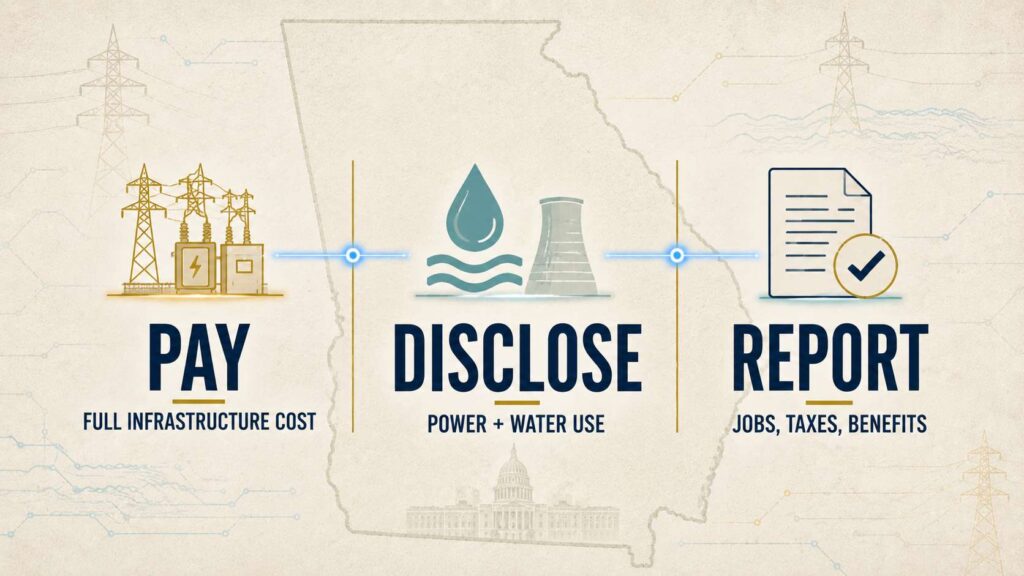
Pay the full cost of power infrastructure. Disclose water use. Use the lowest reasonable water-consumption technology. Protect housing and transit land. Be honest about jobs. Reform incentives. Report annually. Put community benefits in writing. Make the public bargain visible.
That is not anti-growth.
That is how Georgia grows up as a technology state.
Sources
- CBRE: Atlanta Emerges as One of North America’s Fastest Growing Data Center Hubs
- Pew Research Center: Most new data centers in the U.S. are coming to rural areas
- Georgia PSC Data Center Fact Sheet
- Metropolitan North Georgia Water Planning District: Data Centers and Water Resources
- Georgia Department of Audits and Accounts: Georgia Data Center Sales and Use Tax Exemption
- GPB: Atlanta City Council bans data centers along BeltLine
- GPB: Outrage over surge of data centers in Georgia inspires wave of bipartisan bills




1 comment