



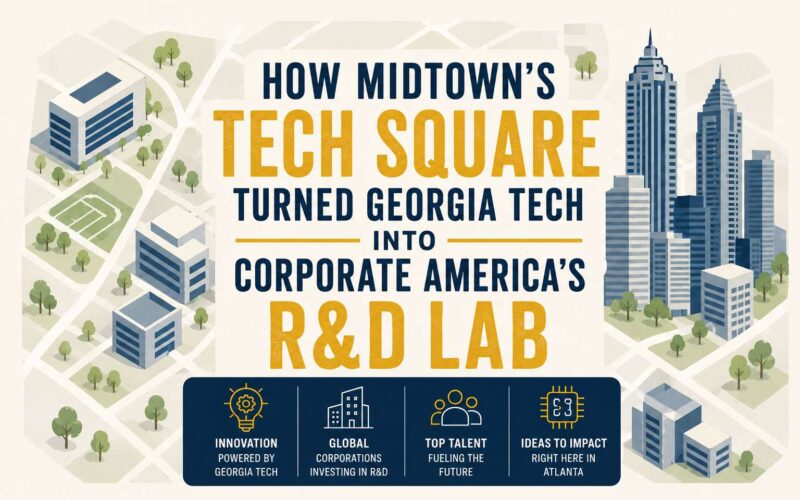
If Alpharetta’s tech identity is built on enterprise anchor tenants and Buckhead’s is built on founder density, Midtown’s is built on something that didn’t exist anywhere in Atlanta before 2003: a five-block stretch of West Peachtree Street where Fortune 500 R&D, university research, venture capital, and early-stage startups all sit inside walking distance of each other on purpose.
That stretch is Tech Square, and it is the single most consequential piece of physical infrastructure in the modern Atlanta tech story. It was conceived as a way to drag Georgia Tech across the I-75/I-85 connector into Midtown proper. It has, twenty-plus years on, become the place where roughly thirty global corporations have decided to do at least some of their forward-looking technology work in Atlanta rather than Silicon Valley, Boston, or New York.
This is the third piece in our series on the geography of Metro Atlanta tech, following our foundational Alpharetta and Buckhead pieces. Midtown is the part of the story most outsiders already think they know. The thing they tend to miss is how deliberately constructed it is.
The Tech Square Bet
In August 2003 Georgia Tech opened Technology Square — a $179 million development at the intersection of Fifth Street and West Peachtree that included the Scheller College of Business, a hotel and conference center, a Barnes & Noble bookstore that doubled as the campus bookstore, and the Centergy Building, the first office tower designed explicitly to put corporate tenants next to a university computer-science department.
The thesis was specific and, at the time, contrarian: the most valuable thing a research university could do for a regional economy was not produce more graduates, but reduce the friction between its researchers and the corporations that might want to work with them. If you put the people in the same building, the partnerships would compound on their own. Bud Peterson, who served as Georgia Tech president from 2009 to 2019, would later describe Tech Square’s growth during his tenure as the most important institutional outcome of his presidency.
What followed is, by any reasonable measure, the most successful corporate-innovation-district experiment in the American South. The Centergy Building filled up. AT&T opened the AT&T Foundry in 2013, and the Foundry remains an active corporate-innovation tenant in Tech Square in 2026. Panasonic established the Panasonic Innovation Center on the Georgia Tech campus, which continues to operate as a hub for Panasonic Automotive Systems Company of America to collaborate with Georgia Tech students and faculty. Coca-Cola, Home Depot, Delta, Anthem, NCR, Worldpay, Cisco, Boeing, Honeywell, Southern Company, State Farm, UPS, NTT Data, Equifax, AB InBev, Georgia-Pacific, and Chick-fil-A followed. By 2019, when the Coda Building opened at 756 West Peachtree Street — a 770,000-square-foot, Portman-developed tower anchored by Georgia Tech’s high-performance computing center — Tech Square had become the largest corporate-innovation-center cluster in the country outside Cambridge, by most counts somewhere north of thirty active centers at peak.
The most recent buildout, the Scheller Tower expansion on Spring Street, brought additional Georgia Tech and corporate space online over 2023 and 2024 and pushed Tech Square’s gravitational pull further east toward the connector.
What the Corporate Innovation Centers Actually Do
The honest accounting of what these centers produce is harder than the marketing suggests. Some of them are essentially recruiting outposts dressed up as labs — a way for a Fortune 500 to be near Georgia Tech computer-science talent without committing to a full Atlanta engineering org. Some of them produce real, shipping product work — AT&T’s Foundry meaningfully influenced the company’s early 5G developer-platform strategy, and Delta’s Tech Square presence has been central to the airline’s operations-research and customer-experience modernization. Some of them have come and gone with the corporate strategy that funded them, leaving behind a Tech Square address on a press release and not much else.
The most useful way to think about the cluster, in 2026, is as a talent pipeline anchored to the country’s most underrated computer-science department. Georgia Tech’s College of Computing graduated roughly 2,400 students at the bachelor’s, master’s, and doctoral level in the 2024–2025 academic year. The corporate innovation centers exist, in large part, to be the place those graduates encounter their first employer at scale. That this happens inside a five-block walk of the classrooms they just left is the design feature.
That pipeline is what the corporate sponsors are actually paying for, and it is why the centers have proven more durable than the cynical read would suggest. Some of them shrink. Some of them rebrand. The cluster, in aggregate, persists.
Engage Ventures and the Corporate-Venture Layer
Sitting on top of the innovation-center cluster is one of the more interesting institutional experiments in American corporate venture: Engage Ventures, founded in 2017 as a partnership between Tech Square Ventures (Blake Patton’s early-stage firm) and an unusual roster of corporate sponsors — Coca-Cola, Delta, AT&T, Goldman Sachs, Home Depot, Chick-fil-A, UPS, Cox Enterprises, Equifax, Georgia-Pacific, and Invesco, among others.
Engage runs a structured program: founders go through a roughly twelve-week immersion, meet senior operators inside the corporate partners, and emerge with both capital and (more importantly) direct relationships with potential first enterprise customers. The model is unusual because it inverts the typical corporate-VC dynamic — instead of one strategic investor trying to extract optionality from a startup, a dozen corporates collectively try to give early-stage B2B companies a way through the Fortune 500 sales motion they would otherwise have to brute-force.
Engage has, by its own reporting, supported more than 100 portfolio companies since launch. Its alumni include companies like Florence Healthcare, Stord, Greenzie, and SingleOps. Tech Square Ventures itself remains the active investing arm; Engage is the curated funnel.
This corporate-venture layer is the part of Midtown’s story that is most often missed in outside coverage of Atlanta tech. The presence of these companies in a single program — meeting founders before they have product-market fit — is the closest thing the Southeast has to the corporate-customer-access flywheel that companies like Y Combinator’s enterprise network provide in California.
ATDC, Create-X, and the Founder Pipeline
Predating Engage by almost forty years, the Advanced Technology Development Center (ATDC) is Georgia Tech’s startup incubator. Founded in 1980, ATDC is one of the oldest university-affiliated tech incubators in the United States and the longest continuously operating one in the South. It is housed in the Centergy Building at Tech Square. It is also the institution from which much of modern Atlanta software actually emerged — MailChimp, Pindrop, Florence Healthcare, Greenlight, Stord, and dozens of other companies that now define the Atlanta startup map were ATDC graduates at some point in their early lives. As of early 2026, ATDC reports approximately 200 active companies in its portfolio across signature, accelerate, and educate programs.
ATDC is led by general manager John Avery. The institution remains the most important early-stage on-ramp for technical founders in the state, and we will be doing a longer piece on ATDC’s current programs and direction shortly.
Create-X, Georgia Tech’s undergraduate entrepreneurship program founded in 2014, sits on top of ATDC and the corporate-innovation infrastructure. The program runs a summer launch accelerator that, in 2025, supported more than 100 startups out of its Tech Square space. Create-X has now produced more than 600 student-founded companies in its decade-plus of operation. Some of them are toys. Some of them are not — the program has produced multiple seven- and eight-figure funded outcomes already, and the pipeline of repeat founders coming out of it will, in our view, materially change the shape of Atlanta tech across the next decade.
This is the layer that most other Southeastern metros simply do not have. Birmingham, Nashville, Charlotte, and Tampa all have growing startup ecosystems. None of them have a Georgia Tech, an ATDC, and a Create-X sitting on top of an Engage Ventures.
The Anchor Tenants: NCR Voyix, Salesloft, and the West Peachtree Corridor
Midtown’s reputation has historically been built on Tech Square. Its day-to-day office market is built on a longer stretch of West Peachtree and Peachtree Street running from North Avenue up to 14th Street.
NCR Voyix — the digital-commerce business that emerged from NCR’s October 2023 split into NCR Voyix and NCR Atleos — is headquartered at 864 Spring Street, the building NCR opened as its global headquarters in early 2018 after relocating from Duluth. The Spring Street campus, designed around a Tech Square-adjacent corporate culture, remains NCR Voyix’s center of gravity. The company has also been through a difficult two-year period: the post-split entity sold its Digital Banking business to Veritas Capital in a deal that closed in 2024, divesting roughly 5,500 employees in the process; additional restructuring through 2024 and 2025 has further shrunk the operating footprint. As of early 2026, NCR Voyix continues to list Midtown Atlanta as its headquarters and remains one of the largest publicly traded technology employers in the city, but it is a meaningfully different company than the one that broke ground on the Spring Street campus a decade ago.
Salesloft, as we covered in the Buckhead piece, is headquartered at 1180 West Peachtree Street and remains one of Midtown’s most visible privately held tech employers, with roughly 1,150 employees as of February 2026. The December 2025 merger with Clari brings new leadership and an open question about long-term Atlanta headcount.
Florence Healthcare, the clinical-trial software platform, is on Peachtree Street near 12th. It is, by most measures, one of the quieter compounders in Atlanta tech — its work is in 600-plus sponsor organizations and 90-plus countries, and it does not generate the news cycle that flashier consumer companies do.
A handful of other operating companies cluster in or adjacent to Midtown — Greenlight Financial toward downtown on Peachtree Street, OneTrust on Angier Avenue along the BeltLine, Pindrop in West Midtown on Howell Mill Road. The Midtown office market itself has captured the largest share of new tech leasing in metro Atlanta over the past two years, a trend that has accelerated as Buckhead’s older monolithic product has fallen out of favor with growth-stage tech tenants.
What didn’t survive
The honest Midtown story has to include the corporate retreats, and also has to distinguish between projects that paused and projects that are operating. Microsoft is the canonical case where outside coverage routinely conflates the two. The company’s Atlantic Yards campus at 200 17th Street NW — a 523,000-square-foot Midtown facility that opened in 2022 and anchors a meaningful Microsoft engineering, sales, and customer-engagement presence in the city — is open and operational. The separate, much larger 90-acre Westside campus near Bankhead, announced as part of a multi-billion-dollar regional expansion projected to eventually house up to 15,000 employees, was paused by Microsoft in 2023 and has not resumed at the originally announced scale. The two are easy to conflate and frequently are. Atlantic Yards is the operating Microsoft Atlanta campus; the Westside acreage is the paused vision.
Cisco’s Midtown innovation center, which opened in the Coda Building in 2019, has been buffeted by multiple rounds of Cisco-wide layoffs across 2023, 2024, and 2025. The Atlanta footprint persists but is smaller. Some other corporate-innovation tenants have similarly contracted or consolidated their Tech Square presence as parent-company strategy has shifted.
These are not existential problems for Midtown’s tech identity. They are real ones, and they are part of a broader shift away from the early-2020s peak in corporate-innovation-center commitments. The cluster has, in aggregate, held up; the individual sponsors have not all held up equally.
The office market reflects the same dynamic. Metro Atlanta sublease availability remains elevated even as it has come down from its 2023 peak. Midtown’s Class A leasing has outperformed Buckhead’s, but at lower headline rents than its pre-2020 peak, and with the same hybrid-work demand drag that is affecting every major American office market.
Where this Leaves Us
Midtown is the part of Atlanta tech that the world already thinks it knows, and the part that the world most consistently underestimates. The corporate-innovation-center cluster at Tech Square is, in 2026, more institutionally important than its individual sponsors are durable. The Engage Ventures model has produced one of the more interesting corporate-venture experiments in the country. ATDC and Create-X together produce a pipeline of founders that does not exist in any other Southeastern metro at this scale. And the West Peachtree corridor’s anchor tenants — NCR Voyix, Salesloft, Florence Healthcare, and the long tail of operating companies behind them — remain a meaningful slice of the Atlanta tech employment base even after a difficult two years of corporate restructuring.
In coming weeks we’ll publish the Downtown foundational piece — the South Downtown thesis, Centennial Yards, the Russell Innovation Center for Entrepreneurs, the Norfolk Southern campus, and the bet on a 40-to-50-year revitalization that David Cummings and Jon Birdsong are running out of the old C&S Bank building. We’ll also turn to the Central Perimeter — Sandy Springs, Dunwoody, and Roswell — which is its own meaningful enterprise hub and which most coverage of “Atlanta tech” leaves out entirely.
If you’re working in Midtown — at Tech Square, at one of the corporate innovation centers, at ATDC, at Create-X, or at one of the operating companies along West Peachtree — and you have a story we should be covering, send us a note. The whole point of Atlanta Tech News is to be the publication that takes that note seriously.
Atlanta Tech News covers the people, companies, and institutions building technology across Metro Atlanta — from Alpharetta to Downtown. Subscribe to our daily newsletter to get our reporting in your inbox every weekday.



1 comment