


If Alpharetta is metro Atlanta’s north-side corporate technology corridor, and Buckhead is the startup center of gravity, Sandy Springs, Dunwoody and Roswell occupy a different role: they are the enterprise-tech arc.
This is not the part of Atlanta tech that gets photographed at pitch nights. It is the part that runs payroll, moves packages, prices markets, routes broadband, processes insurance, modernizes restaurant operations, supports digital banking, staffs technology teams, and absorbs the shocks when large corporate innovation centers change strategy.
That makes it easy to under-cover. It also makes it hard to understand Atlanta tech without it.
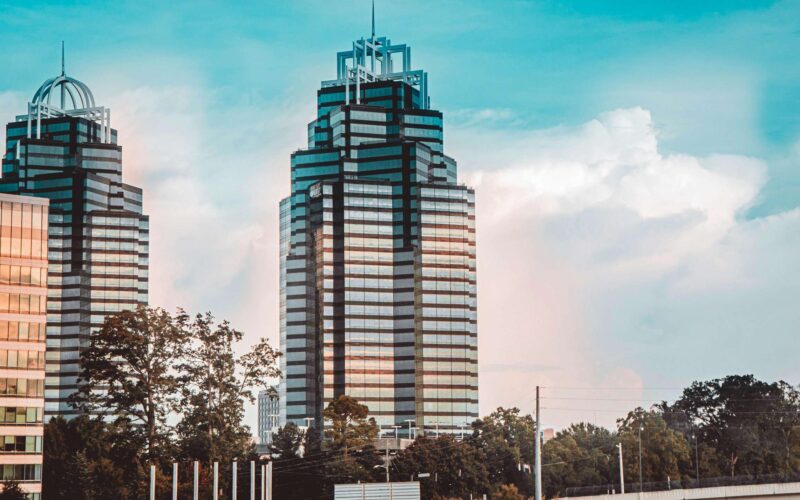
The geography matters. Sandy Springs and Dunwoody sit where GA-400 meets I-285, wrapped around Perimeter Center, MARTA’s Red Line, the King and Queen towers at Concourse, and one of the largest suburban office markets in the Southeast. Roswell sits just north and east, connected to the same talent shed but with a different economic-development story: smaller corporate footprint, more mid-market and advanced-manufacturing activity, and a very visible reminder that not every tech announcement ages into a permanent employer.
This is the final overview piece in ATN’s first geographic series on metro Atlanta tech. We saved this one for last because it is the least tidy. It is also one of the most important.
The Sandy Springs headquarters stack
Sandy Springs is not usually described as a tech city. Its own employer base says otherwise.
The city’s 2025 Annual Comprehensive Financial Report, using business-license filings, lists several companies with real technology relevance among its largest employers: UPS General at 2,798 employees, Optomi at 2,000, Cox Enterprises at 1,484, Cox Communications at 1,343, Intercontinental Exchange at 1,319, Inspire Brands and subsidiaries at 1,211, Cisco Systems at 821, and Newell Brands at 980. Not all of those are “tech companies” in the narrow venture-capital sense. But the work inside them is deeply technical.
UPS, headquartered at 55 Glenlake Parkway, is a logistics company, but modern logistics is software, routing systems, industrial automation, data science, and network optimization at planetary scale. Cox is a media, broadband and automotive company, but Cox Careers describes its technology roles across software engineering, cloud engineering, cybersecurity, data science, AI, UX, product and full-stack development. Cox Automotive’s portfolio – Kelley Blue Book, Autotrader, Manheim, Dealer.com and others – is a major automotive-data and marketplace platform hiding inside a family-owned Atlanta enterprise.
Intercontinental Exchange may be the most under-discussed Sandy Springs tech company in the region. Founded in Atlanta in 2000, ICE describes its business as digital networks that combine data, technology and market infrastructure. It operates global exchanges and clearing houses, owns the New York Stock Exchange, provides data services, and has built a major mortgage-technology platform through acquisitions including Ellie Mae. If Atlanta wants to claim financial technology as one of its core industries, ICE has to be in the conversation.
Inspire Brands is the restaurant-company version of the same story. The parent of Arby’s, Buffalo Wild Wings, Sonic, Jimmy John’s, Dunkin’ and Baskin-Robbins is headquartered at Three Glenlake Parkway, but the tech story sits beneath the brands: digital ordering, loyalty, restaurant operations, payments, marketing data, kitchen equipment and robotics. Inspire says it operates more than 33,300 restaurants globally and has generated more than $11 billion in U.S. digital sales. Its Sandy Springs Innovation Center gives teams a 15,000-square-foot space to test kitchen equipment, robotics, modular stations and marketing production. A separate contractor description of an Inspire IT Innovation Lab in Sandy Springs details seven IT labs, a server room, an innovation lab and more than 130 workstations.
Then there is Candescent, the digital-banking platform carved out of NCR Voyix’s former digital banking business and acquired by Veritas Capital in 2024. In September 2025, Candescent opened a new Sandy Springs headquarters at 4 Concourse Parkway NE, housing leadership, product, technology and client-success teams. The company says it serves more than 1,300 financial institutions and 30 million customers and members.
That is a serious fintech asset sitting in the Perimeter market.
Dunwoody’s State Farm lesson
Dunwoody’s tech identity starts with State Farm’s Park Center campus.
The project is enormous. Cooper Carry describes Park Center as a 17-acre regional hub completed in 2021 and home to more than 6,000 State Farm employees, with a direct connection to the Dunwoody MARTA station. KDC, the developer, says State Farm originally wanted hub locations that could consolidate as many as 8,000 employees and selected Dunwoody for transit, walkable amenities, schools, housing and talent.
That matters because insurance is now a technology business. Pricing, underwriting, claims, catastrophe modeling, mobile customer experience, data governance, cybersecurity and automation all sit inside the operating model. State Farm’s Dunwoody campus is not an “insurtech startup,” but it is one of the largest insurance-technology employment centers in the metro area.
The campus also captures the post-2020 office-market reality. In 2024, Dunwoody approved a shift in the final Park Center phase away from a fourth office tower and toward a hotel and 300 apartments, after KDC argued the office market no longer supported the original plan. That is not a failure of the State Farm project. It is a useful signal: even the strongest corporate campuses are being reworked around hybrid work, housing demand and mixed-use economics.
Dunwoody also picked up a meaningful technology headquarters move. Innova Solutions, a global technology and talent-services company, lists its global headquarters at 1455 Lincoln Parkway East in Atlanta, GA 30346. Rough Draft Atlanta reported in 2024 that the company purchased the 186,000-square-foot Central Perimeter building and planned to move its headquarters from Duluth, occupying roughly 50,000 square feet and bringing about 300 corporate staff into the market. Innova says it employs roughly 50,000 people globally and provides digital transformation, IT services, talent and consulting solutions.
That move says something about Perimeter’s appeal: even as large-office demand softens, the submarket remains attractive to companies that need airport access, north-metro talent, executive housing, restaurants, hotels, transit and a location that splits the difference between Alpharetta, Buckhead, Midtown and Gwinnett.
The region is trying to formalize itself
For years, the Perimeter market functioned as a powerful business district without the kind of tech ecosystem branding that Alpharetta built around Tech Alpharetta, now Tech North Atlanta, or that Midtown built around Tech Square.
That is changing, slowly.
In 2025, the Sandy Springs Perimeter Chamber and the Dunwoody Perimeter Chamber merged into the Greater Perimeter Chamber, creating a single business organization for Sandy Springs, Dunwoody and the broader Perimeter region. The chamber describes the area as home to Fortune 500 companies and industries including healthcare, financial services and technology.
The two cities have also studied whether Perimeter could become a more deliberate fintech or insurtech hub. A Joint Entrepreneurship & Innovation Strategy for Dunwoody and Sandy Springs explored the possibility of a Perimeter FinTech/InsurTech Hub or accelerator, with potential corporate sponsors and a structure that could connect startups to enterprise buyers.
That idea is still more strategy than institution. But the logic is strong. ICE, Candescent, State Farm, Optomi, Cox, UPS and the broader corporate base create the customer side of an innovation market. What Perimeter does not yet have is a widely recognized front door for founders, operators, investors and corporate innovation teams to find each other.
That is the gap to watch.
Roswell’s harder story
Roswell belongs in this feature for a different reason. It is part of the same north Fulton talent market, but its technology story has been more uneven.
The biggest recent example is General Motors. GM opened its Georgia Innovation Center in Roswell in 2013, initially promoted by state economic-development officials as a $26 million investment that would create 1,000 high-tech jobs in software development, project management, database work, business analysis and IT. In October 2025, GM said it would close the Roswell-based Georgia IT Innovation Center as part of a broader technical-site restructuring. Atlanta News First reported that the center had served as a hub for software development, IT operations and vehicle technology. Other reporting put the job impact at roughly 300 to 325 positions.
The GM closure is precisely why ATN has been cautious about old press releases throughout this series. Announcements are intentions. Outcomes are the story.
Roswell does have a new technology-adjacent win worth watching: PBS Aerospace. The Czech aerospace manufacturer opened its U.S. headquarters in Roswell in September 2025, establishing a North American manufacturing and R&D hub for small turbojet engines at 1350 Northmeadow Parkway. PBS says the project represents a $20 million investment and plans to hire about 100 workers, with a focus on U.S. defense customers.
That is not the same kind of tech story as a software innovation center. It is advanced manufacturing, aerospace engineering and defense supply chain. But in metro Atlanta’s actual tech economy, those categories increasingly overlap. The line between “manufacturing” and “technology” is thinner every year.
Roswell’s role, then, is not to mimic Alpharetta or Buckhead. Its role may be to become a more selective landing spot for advanced technical operations that want north Fulton talent without needing a giant campus.
What makes the arc different
The Sandy Springs-Dunwoody-Roswell arc does not have a single mythology. There is no equivalent of Atlanta Tech Village, Tech Square or “Technology City of the South.”
What it has instead is operating density.
The executives and technologists working in this arc are less likely to call themselves part of “the startup scene.” They are more likely to be running product, data, infrastructure, security, payments, cloud, logistics, analytics, engineering, support or transformation functions inside large companies. The work is quieter. The impact is not.
That gives the region a different editorial profile for Atlanta Tech News. We should cover the big headquarters and campuses, yes. But the better stories may sit one layer down: how UPS is using AI in logistics; how Cox Automotive is changing auto retail; how ICE’s mortgage-tech stack evolves; whether Candescent becomes a durable Sandy Springs fintech anchor; how State Farm’s Dunwoody hub adapts to hybrid work; whether Perimeter can turn its corporate base into a real fintech/insurtech innovation platform; what happens to the former GM talent pool in Roswell; whether PBS Aerospace actually scales from announcement to production.
Those are not ribbon-cutting stories. They are ecosystem stories.
Where this leaves us
Metro Atlanta’s tech geography is now clearer than it was when we began this series.
Alpharetta is the north-metro corporate tech corridor. Buckhead is the startup center of gravity. Midtown is the university-and-corporate-innovation engine. Downtown and South Downtown are comeback bets tied to capital, real estate, entrepreneurship and institutional reinvention. Sandy Springs, Dunwoody and Roswell are the enterprise-tech arc: less theatrical, more operational, and central to how technology actually gets deployed across large businesses.
That is why the region deserves its own feature.
If you work in Sandy Springs, Dunwoody or Roswell tech – inside a headquarters, a corporate innovation team, a software group, an IT-services firm, a fintech platform, an insurance operation, a logistics team, or a technical manufacturer – send us a note. We are building the map in public, and we want the people doing the work to help us make it accurate.
Atlanta Tech News covers the people, companies, and institutions building technology across Metro Atlanta – from Alpharetta to Downtown. Subscribe to our daily newsletter to get our reporting in your inbox every weekday.
Sources
- City of Sandy Springs 2025 Annual Comprehensive Financial Report: https://up.sandyspringsga.gov/sites/default/files/2025-12/2025%20Annual%20Comprehensive%20Financial%20Report%20%28ACFR%29.pdf
- Cox Careers: Technology roles: https://jobs.coxenterprises.com/Career-Areas/Technology?CloudSearchLocation=none&prefilters=none
- Intercontinental Exchange: About ICE: https://www.ice.com/about?mod=article_inline
- Inspire Brands: Innovation Center: https://inspirebrands.com/timeline/inspire-brands-innovation-center-opens/
- Inspire Brands: About Us: https://inspirebrands.com/about-us/
- Barnsley Group: Inspire Brands IT Innovation Lab: https://barnsleygroup.com/project/inspire-brands-innovation-center/
- Candescent Sandy Springs headquarters announcement: https://www.businesswire.com/news/home/20250917740880/en/Candescent-Unveils-New-Headquarters-in-Atlanta-Signaling-Bold-Vision-for-the-Future-of-Digital-Banking
- Candescent: About Us: https://www.candescent.com/about-us
- Cooper Carry: State Farm Park Center: https://www.coopercarry.com/projects/park-center-state-farm-regional-hub/
- KDC: State Farm at Park Center Phase II: https://kdc.com/our-work/state-farm-at-park-center-phase-ii
- Innova Solutions global locations: https://innovasolutions.com/company/global-locations/
- Rough Draft Atlanta: Innova Solutions buys Central Perimeter building: https://roughdraftatlanta.com/2024/01/17/innova-solutions-buys-building/
- Greater Perimeter Chamber merger announcement via Metro Atlanta CEO: https://metroatlantaceo.com/features/2025/01/introducing-greater-perimeter-chamber-unified-force-driving-business-growth-and-innovation/
- Dunwoody and Sandy Springs Joint Entrepreneurship & Innovation Strategy: https://www.dunwoodyga.gov/home/showpublisheddocument/2397/638760029325670000
- Atlanta News First: GM to close Roswell tech center: https://www.atlantanewsfirst.com/2025/10/28/gm-cut-jobs-close-tech-center-metro-atlanta/
- Georgia Department of Economic Development: GM Innovation Center announcement archive: https://georgia.org/video/gm-innovation-center
- PBS Aerospace U.S. headquarters grand opening in Roswell: https://www.pbsaerospace.com/en/news/pbs-aerospace-celebrates-grand-opening-of-us-headquarters-in-roswell