



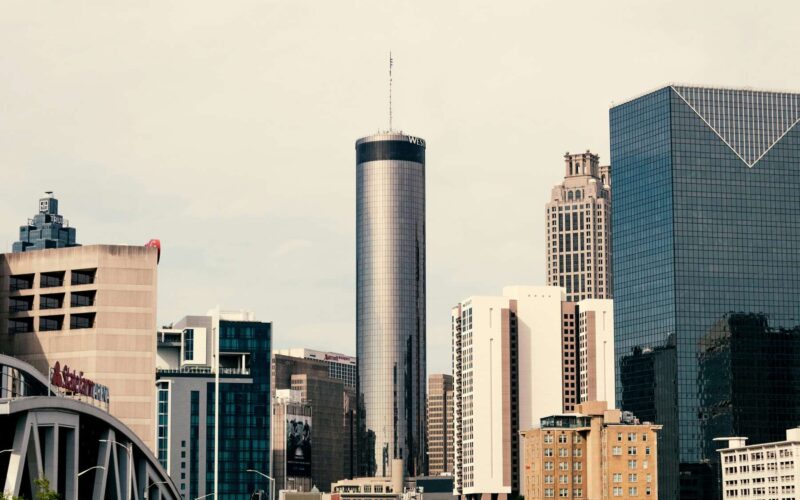
The city of Atlanta was founded around a railroad junction. For most of the last century, the literal center of that junction — a roughly 40-acre depression of rail lines, viaducts, and surface parking known as “the Gulch” — sat in the middle of Downtown as a void the city had organized itself around and then learned to ignore.
That is the cleanest possible metaphor for Downtown Atlanta’s relationship with its own economy. The three pieces in this series so far have each described a place that built a tech identity. Alpharetta did it with deliberate municipal infrastructure. Buckhead did it with founder density radiating out of a single building. Midtown did it with an engineered corporate-research cluster. Downtown is the only one of the four where the story is fundamentally a reclamation — an attempt to put a modern technology economy into a place that spent four decades losing the economy it already had.
This is the fourth piece in our series on the geography of Metro Atlanta tech, following our foundational Alpharetta, Buckhead, and Midtown pieces. It is also the hardest one to write honestly, because Downtown is where Atlanta’s appetite for big announcements most consistently outruns its record of delivery. We are going to try to separate the two.
(One housekeeping correction: in our Midtown piece we flagged the Norfolk Southern headquarters campus as a Downtown subject. On a closer look it sits firmly on Midtown’s southern edge along Spring Street and belongs to that story, not this one.)
The hollowing out
To understand why Downtown’s tech story starts from behind, you have to understand what happened to Downtown’s economy generally.
For the first half of the twentieth century, Downtown was Atlanta — the department stores, the banks, the newspaper, the office towers, the government. Then, over roughly the period from the 1970s through the 2000s, the commercial center of gravity left. It went to Midtown, to Buckhead, to the suburban office parks of Sandy Springs and Alpharetta. The drivers were the familiar postwar American ones — highways, white flight, cheaper suburban land, the office market’s preference for new product over old — and the result was a Downtown that kept its government buildings, its convention business, and its sports venues, but lost the dense daytime population of knowledge workers that a tech economy needs.
By the 2000s, Downtown had a particular kind of problem: beautiful early-twentieth-century building stock, much of it in the South Downtown district around Broad Street and Mitchell Street, sitting vacant or barely occupied. The bones of a great urban neighborhood, with almost no economic activity inside them. Underground Atlanta — the below-grade retail and entertainment district near Five Points — became the recurring symbol of the pattern: redeveloped, celebrated, allowed to decline, sold, and slated for reinvention again, across multiple cycles, for decades.
Any honest account of “Downtown tech” has to start here, because it explains why the institutions that did hold the line matter so much.
Georgia State, the anchor that held
The single most important reason Downtown did not fully empty out is Georgia State University.
While the private market was leaving, GSU was doing the opposite — steadily buying, building, and occupying Downtown real estate, decade after decade, until it became the dominant landholder and the dominant daytime population in the urban core. Today GSU enrolls more than 50,000 students across its campuses, the largest enrollment of any university in Georgia, and its Downtown campus is woven directly into the street grid around Woodruff Park and the old commercial district. The 2016 consolidation with Georgia Perimeter College extended its reach further across the metro.
For tech specifically, GSU matters in three ways. It is a volume producer of computer science, data science, and analytics graduates who already live and study Downtown. Its Robinson College of Business and its analytics programs feed the same Fortune 500 and fintech employers that the rest of this series has been mapping. And its Creative Media Industries Institute, on Centennial Olympic Park Drive, is a deliberate bet on the film, game, and digital-media production economy that Georgia’s tax-credit regime has built — a workforce pipeline for an industry that is genuinely large in this state and genuinely under-connected to the “Atlanta tech” conversation.
GSU is not a flashy part of the story. It is the load-bearing one. Without it, there is no Downtown daytime economy to build a tech narrative on top of.
The Atlanta University Center and the talent question
Just west of Downtown sits an institution that should be central to any serious conversation about the future of Atlanta tech, and usually isn’t: the Atlanta University Center Consortium.
The AUC is the oldest and largest consortium of historically Black colleges and universities in the country — Clark Atlanta University, Morehouse College, Spelman College, and the Morehouse School of Medicine, clustered together on the west side of Downtown. Together they enroll roughly 10,000 students, and they produce a strikingly large share of the nation’s Black graduates in STEM fields. Spelman is consistently among the top producers of Black women who go on to earn doctorates in science and engineering. Morehouse and the dual-degree engineering programs have a similar record on the men’s side.
This matters for Atlanta tech for a reason that goes beyond the numbers. Atlanta’s identity as a “Black Mecca” — a center of Black political power, Black wealth, Black culture, and Black higher education — is one of the genuinely distinctive things about this city’s economy, and the AUC is its intellectual core. In recent years the consortium and its member schools have built data science programming, AI curricula, and tech-industry partnerships explicitly aimed at moving more of that talent into technology careers and founder roles. The AUC Data Science Initiative, launched with corporate and philanthropic backing, is the most visible piece of that effort.
The open question — and it is a real one, not a rhetorical one — is whether Atlanta’s tech economy actually captures that talent, or whether it exports it to employers in other cities. A meaningful share of AUC STEM graduates leave the metro. Closing that gap is arguably the highest-leverage single thing Atlanta tech could do for its own long-term depth, and it is a story Atlanta Tech News intends to cover as a continuing beat rather than a one-time feature.
RICE, The Gathering Spot, and the institutions of Black entrepreneurship
The most concrete institutional answer to that question sits just south of Downtown, in the historic Castleberry Hill arts-and-warehouse district: the Russell Innovation Center for Entrepreneurs, known as RICE.
RICE was founded in 2016, and its renovated 54,000-square-foot home at 504 Fair Street SW opened in 2021. The organization describes itself — credibly — as the largest center of its kind in the country: a “business generator” built to help Black entrepreneurs overcome the specific barriers they face in building and scaling companies. It is named for Herman J. Russell, the Atlanta construction and real estate magnate who built H.J. Russell & Company into one of the largest Black-owned businesses in the United States, and who was woven into the civil rights movement’s financial infrastructure during its Atlanta years. Naming the building for Russell is not incidental. It is a deliberate statement that Black entrepreneurship in Atlanta has a multi-generational history, and that RICE is meant to be its next chapter.
Under president and CEO Jay Bailey, RICE has built programming, capital access, mentorship, and physical space for hundreds of Black-owned businesses, with a growing emphasis on technology and scalable companies rather than only small-business services. It is one of the few places in the metro where the racial-equity conversation in tech has a permanent physical home and an operating budget rather than a panel discussion.
RICE is the institutional anchor, but it is not the only one. The Gathering Spot, founded in Atlanta in 2016 by Ryan Wilson and T.K. Petersen, plays a different and complementary role. It is a private membership club — part co-working space, part event venue, part deliberately engineered network — and it has become one of the most important convening places for Black founders, executives, and creatives in the city. The relationship infrastructure that startups actually run on — the introductions, the informal capital conversations, the warm handoffs — is exactly what The Gathering Spot was built to manufacture. The model worked well enough to expand to Washington, D.C. and Los Angeles, and in 2021 the club was acquired by Greenwood, the Black-owned digital banking company. That arrangement proved short-lived and contentious: after a 2023 legal fight — the founders alleged Greenwood had withheld millions in acquisition payments, and Greenwood countersued over alleged financial misrepresentations — Wilson and Petersen reacquired majority ownership in December 2023 and returned the club to independent operation, with the two sides ultimately settling and maintaining a general partnership. The Gathering Spot has since expanded again, bringing on investors including Charles Barkley and T.I. and taking space in The Interlock development on Howell Mill Road. Ten years in, it reads less like a startup than an established Atlanta civic institution. For minority-owned startups in particular, it functions as connective tissue that the formal institutions — incubators, VC firms, university programs — do not by themselves provide.
For a media outlet trying to cover the whole technology ecosystem of Metro Atlanta — which is the entire premise of this publication — RICE and The Gathering Spot are not niche topics. They are among the defining institutions of what makes Atlanta’s ecosystem different from Austin’s or Denver’s or Raleigh’s.
Disclosure: MyMobileLyfe, a digital marketing company owned by Atlanta Tech News founder Rick Hancock, provided marketing consulting services to RICE in 2019 and 2020. We note the relationship in the interest of transparency.
South Downtown’s slow bet
Which brings us to the real estate — and to the place where the press-release-versus-reality discipline matters most.
The most ambitious tech-adjacent bet in the urban core is the South Downtown revitalization. As we reported in our Buckhead piece, David Cummings and Jon Birdsong — the founder and the venture partner behind Atlanta Tech Village’s flywheel — have assembled a large portfolio of historic South Downtown buildings, on the order of a million square feet, with a stated 40-to-50-year horizon for revitalizing the neighborhood. The plan that has been publicly discussed includes residential conversions (the former C&S Bank headquarters at 222 Mitchell Street, planned for roughly 220 units, plus smaller residential projects on Peachtree and Mitchell), and an Atlanta Tech Village South Downtown campus that opened to programming in January 2025.
The thesis is a direct transplant of the original ATV bet: physical density of founders, in cheap and characterful space, compounds into ecosystem outcomes. Applied to a disinvested historic district instead of a Buckhead office building, it becomes one of the most ambitious urbanist bets anyone in Atlanta tech is currently making.
It is also, by the explicit admission of the people running it, a multi-decade project. South Downtown has absorbed ambitious plans before — a separate, German-backed investor assembled a large South Downtown portfolio years earlier, and progress was slow enough to become a local cautionary tale. The honest status in May 2026 is that the ATV South Downtown campus is real and operating, some residential conversion is underway, and the larger neighborhood transformation is a bet in progress, not an accomplished fact. We will be tracking what actually opens, and when, against what has been announced — and we would specifically welcome readers’ on-the-ground reads, because this is exactly the kind of story where a press release and a walk down Broad Street can tell you two different things.
Centennial Yards and the Gulch
The other megaproject is Centennial Yards — the redevelopment of the Gulch itself.
Centennial Yards is a roughly 50-acre, multi-billion-dollar mixed-use development being built by Los Angeles-based CIM Group on the old railroad-gulch site between Mercedes-Benz Stadium and Five Points. The publicly discussed program is enormous — residential, hotel, office, and a sports-and-entertainment district — and the financing structure, which involved a substantial public-incentive package, was politically contentious when it was approved at the end of the 2010s.
The relevant near-term catalyst is the 2026 FIFA World Cup. Atlanta is a host city, Mercedes-Benz Stadium is a host venue, and Centennial Yards’s first phases — including its entertainment district and initial residential and hotel components — have been targeted at delivering into that window. As of May 2026, parts of the project are opening or near opening, and parts remain construction sites and renderings.
We are deliberately not going to characterize Centennial Yards as a finished tech district, because it is not one, and the history of this exact site rewards skepticism. What it plausibly is is a large new supply of dense, urban, transit-adjacent residential and commercial space in the middle of Downtown — the physical precondition for a knowledge-worker economy, even if it is not itself a tech employer. Whether tech tenants and tech workers actually fill it is the open question, and it is the right thing to watch over the next five years.
The infrastructure nobody writes about
There is one piece of genuine, operating, high-stakes Downtown tech infrastructure that gets almost no coverage: the carrier hotels.
The building at 56 Marietta Street, in the heart of Downtown, is one of the most network-dense interconnection points in the Southeastern United States — a “carrier hotel” where networks physically meet and exchange traffic, with deep roots in Atlanta’s history as a telecommunications hub. It is not glamorous, it does not issue press releases, and most people who work in Atlanta tech could not tell you it exists. But it is part of why Atlanta functions as a connectivity and data-infrastructure node at all, and the metro’s broader data-center economy — much of it now north of the perimeter — sits downstream of interconnection infrastructure like this.
We mention it because a publication that wants to cover the whole ecosystem has to cover the boring, load-bearing parts too. The carrier hotels are on our list.
What hasn’t worked
A credible Downtown story has to be honest about the graveyard of previous Downtown turnaround announcements.
Underground Atlanta has been “coming back” for forty years. Multiple Downtown retail and entertainment revitalizations have been launched, celebrated, and quietly unwound. The Gulch itself sat as a development promise for the better part of two decades before CIM Group’s involvement. And the most recent cautionary note belongs to the Westside, just beyond Downtown’s edge: Microsoft’s 90-acre Westside campus near Bankhead, announced as part of a multi-billion-dollar regional expansion, was paused in 2023 and has not resumed at the originally announced scale. (Microsoft’s operating Atlanta campus, as we covered in the Midtown piece, is the separate Atlantic Yards facility — open and active. The two are routinely conflated.)
The pattern across all of these is the same: Downtown does not have a problem generating ambitious plans. It has a problem converting them, on schedule, into occupied buildings and daytime jobs. The institutions that have actually moved Downtown’s needle — Georgia State, the AUC, RICE — did it by showing up every year for decades, not by announcing a transformation. That is the lens we intend to apply to Centennial Yards and South Downtown as they unfold: not “what was announced,” but “what opened, and who is working in it.”
Where this leaves us
Downtown is the highest-variance chapter in the Atlanta tech story. The downside case is another cycle of renderings. The upside case is genuinely large: a dense, transit-served urban core, anchored by the state’s biggest university and the country’s leading HBCU consortium, with the most significant Black-entrepreneurship institution in America inside its footprint, and two of the most ambitious real estate bets in the region physically under construction. No other part of Metro Atlanta has that specific combination of assets. Whether it converts is the story of the next decade, and it is one we will be covering closely rather than cheering.
In coming weeks we’ll publish the Central Perimeter foundational piece — Sandy Springs, Dunwoody, and Roswell, the enterprise hub around Perimeter Center that anchors a huge slice of metro tech employment and gets almost none of the ecosystem coverage. After that we’ll turn to the Westside and the BeltLine corridor, and to the Clifton corridor around Emory and the CDC, where Atlanta’s health-tech and biotech economy actually lives.
If you’re working Downtown — at Georgia State, in the AUC, at RICE or The Gathering Spot, in the South Downtown buildings, on the Centennial Yards site, or in one of the operating companies and agencies most people forget are down there — and you have a story we should be covering, send us a note. The whole point of Atlanta Tech News is to be the publication that takes that note seriously.
Atlanta Tech News covers the people, companies, and institutions building technology across Metro Atlanta — from Alpharetta to Downtown. Subscribe to our daily newsletter to get our reporting in your inbox every weekday.