



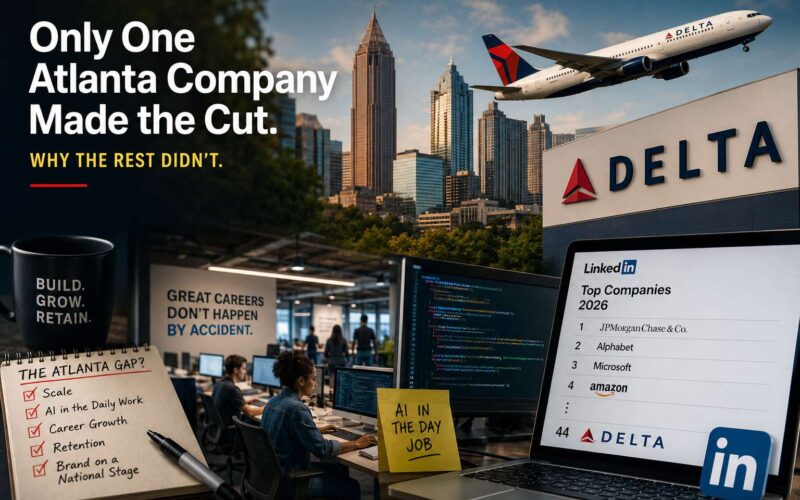
LinkedIn just published its sixth annual Top Companies list — the 50 best U.S. employers for career growth in 2026. The methodology isn’t fluffy. To qualify, a company has to employ at least 5,000 people globally and 500 inside the United States. It can’t have laid off more than ten percent of its workforce in 2025 or seen attrition above that same line. From there, LinkedIn’s data team scores companies across eight pillars: ability to advance, skills growth, company stability, external opportunity, company affinity, gender diversity, educational background, and U.S. employee presence.
JPMorgan Chase landed at number one, ahead of Alphabet, Microsoft, and Amazon. From a Metro Atlanta vantage point, though, the more interesting number is one. That’s how many companies on the list of fifty are headquartered in our city. Delta Air Lines, at number 44, is the only entry with an Atlanta address.
Delta has earned the recognition. Its technology organization is large, sophisticated, and increasingly the engine the airline runs on. But LinkedIn classifies Delta in “Airlines and Aviation,” not Software Development. Which means that for a region that markets itself as “Transaction Alley,” the fintech capital of the South, and a top-five tech-talent metro, our single 2026 representative on the most-watched national employer ranking is technically an airline.
That’s not a Delta problem. It’s an Atlanta problem.
The companies that aren’t on the list
Look at who didn’t make the cut.
Intuit’s Mailchimp business runs out of Ponce City Market with thousands of Atlanta employees and is arguably the city’s most-celebrated homegrown tech success story. Intuit, its parent company, isn’t on the list. Equifax, the consumer-credit and data-analytics giant headquartered in Midtown with roughly 14,000 employees worldwide, isn’t on it either. Global Payments, a Fortune 500 fintech with operations in 38-plus countries and an Atlanta headquarters, isn’t on it. NCR Voyix and NCR Atleos — the two public companies that emerged from the 2023 split of NCR, both still anchored here — aren’t on it. OneTrust, the privacy-management leader with co-headquarters in Atlanta and London, isn’t on it. Calendly, founded in Atlanta in 2013 and now a global brand, isn’t on it. Cox Enterprises and Cox Automotive, both Atlanta-based and tech-forward, aren’t on it. Home Depot, with one of the largest in-house technology organizations of any U.S. retailer, isn’t on it. Coca-Cola isn’t on it. UPS isn’t on it.
Some of those absences have benign explanations. LinkedIn’s ten-percent-attrition and ten-percent-layoff disqualifiers knock out a lot of companies that did major workforce restructuring in 2025 — and Atlanta has had its share. A handful of the names above are below the 5,000-employee floor. Some are private, and don’t surface in LinkedIn’s career-growth data the way public companies do. None of those caveats change the headline.
The headline is that the largest, most stable, and most reputationally premium Atlanta tech employers, evaluated on a national career-growth benchmark, are not making the cut. And the talent that Georgia Tech, Georgia State, Spelman, Morehouse, Clark Atlanta, Emory, and Kennesaw State graduate every May is, in aggregate, growing careers somewhere else.
The JPMorgan lesson Atlanta needs to take seriously
The single most important takeaway from this year’s list isn’t who’s on it. It’s why JPMorgan won. LinkedIn’s editors and a string of follow-on outlets credited the bank’s AI strategy in unusually direct terms — and the details matter for any Atlanta executive trying to reverse-engineer this list.
JPMorgan’s LLM Suite, a proprietary internal generative-AI platform, is reportedly used daily by more than 230,000 of the bank’s roughly 300,000 employees. As of March 2026, AI adoption is formally tied to performance reviews for around 65,000 engineers and technologists, with explicit performance goals for using AI to boost productivity and code quality. The bank’s “AI Made Easy” internal program has trained tens of thousands of non-technical employees. JPMorgan has more than 450 production AI use cases live today and is targeting 1,000 by the end of 2026.
Notice what’s missing from that description. There is no flagship “AI training program.” JPMorgan didn’t win because it built a flashy upskilling track separate from the day job. It won because AI showed up in the day job itself — in code reviews, in customer workflows, in the back office — and because the company made adopting AI a measured part of how an employee gets ahead.
For Atlanta employers, especially fintech and enterprise tech firms that compete with JPMorgan for the same talent, that is the new bar. Not “we offer AI courses on our LMS.” The bar is: AI is in the tools, the metrics, and the promotion path. It is daily, mandatory, and tied to whether a person grows in the role.
That is a very different conversation from the one most Atlanta tech leadership teams are having right now.
What Atlanta has to do next
Three things should follow from this list — and from the AJC’s recent leadership reset, where Andrew Morse stepped down in May after a $150 million digital build that fell roughly 100,000 subscribers short of target. That’s another local proof point that legacy assumptions about workforce, career growth, and digital execution are no longer enough.
First, scale matters. Atlanta has dozens of high-quality tech companies in the 500-to-3,000 employee range that, with growth or strategic combinations, would clear LinkedIn’s qualifying threshold. The next decade of ecosystem-building has to focus as much on growing companies up as on spawning new ones.
Second, AI fluency has to be embedded, not bolted on. Atlanta’s enterprise employers — Delta, Home Depot, Cox, Equifax, Global Payments, NCR Voyix, Intuit’s Atlanta operation, UPS — are large enough to do what JPMorgan is doing. The ones that move first will define what an “Atlanta tech career” means in 2030. The ones that don’t will spend the rest of the decade losing internal talent to the ones that do.
Third, the city’s HBCU and university talent pipeline needs internal ladders to climb. LinkedIn’s eight pillars include “ability to advance” and reward internal mobility heavily. If our best graduates can only grow careers by leaving for New York, San Francisco, or Austin, next year’s list will look exactly like this one.
Delta carrying the flag for Atlanta on the 2026 LinkedIn Top Companies list is a fine story. It is not a sufficient one. Atlanta Tech News is going to spend the next twelve months reporting on the local companies, leaders, and institutions building the kind of career-growth engines this list rewards — and naming the ones that aren’t.
The benchmark is on the table. We have a year to make next year’s list look different.
Sources: LinkedIn Top Companies 2026 list (published April 28, 2026); reporting by Inc., Poets&Quants, and the European Financial Review on JPMorgan Chase’s AI workforce strategy.