


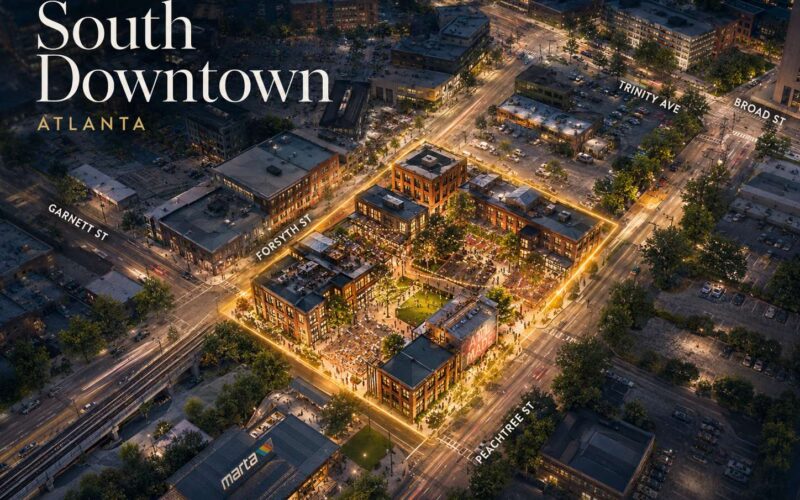
On May 20, 2026, a half-acre parking lot on South Broad Street became Founders Green, a small public park with a stage, seating, and enough open space for concerts, watch parties, and the kind of street-level life Downtown Atlanta has spent decades trying to manufacture. A park is not, by itself, a tech story. In South Downtown, it is one piece of a much larger experiment: whether a group of Atlanta technology entrepreneurs can use real estate, restaurants, public space, and founder density to revive one of the oldest and most neglected parts of the city.
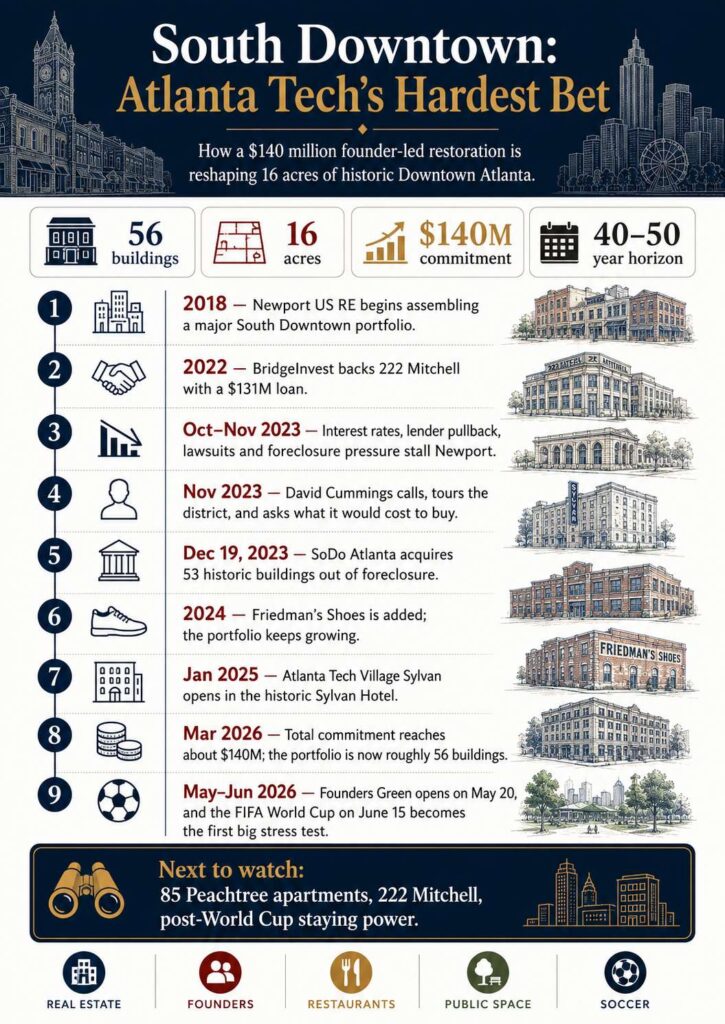
The people running the experiment are not civic planners or a national office developer. They are David Cummings and Jon Birdsong, the Atlanta Ventures and Atlanta Tech Village operators whose first founder-density bet helped make Buckhead nationally relevant in startup circles. Their new canvas is much harder: a portfolio of 53 historic buildings they acquired out of foreclosure in December 2023 for what real estate observers told the Atlanta Business Chronicle may have been a 50 percent or greater discount to what the previous owner spent — a portfolio that has since grown to roughly 56 buildings across 16 acres after additional acquisitions, and against which the total Cummings/Birdsong commitment, as the Chronicle reported in March 2026, now sits at approximately $140 million.
This piece is a deep look at South Downtown specifically, following our foundational Downtown article earlier this month. We are writing it on its own because the South Downtown bet is large enough, slow enough, and strategically distinct enough from the rest of the Downtown story that it deserves to be treated as its own thing rather than a paragraph inside someone else’s article. The 40-to-50-year horizon Cummings has publicly attached to it is not a marketing flourish. It is the actual unit of time the bet operates in. The 2026 FIFA World Cup, with Atlanta’s first match on June 15, is the first short-horizon test of whether early-phase delivery can hold.
The part of Atlanta everyone inherited
South Downtown sits in and around the place where Atlanta began: the railroad-centered commercial district south of Five Points, around Mitchell Street, Broad Street, Forsyth Street, Peachtree Street, and the government buildings that still dominate the area. Before Midtown became Midtown and Buckhead became Buckhead, this was the city.
It was the place of department stores, hotels, shoe companies, pharmacies, lunch counters, banks, wholesalers, and railroad workers. The old names still sit in the brick if you know how to read the buildings: Hotel Row on Mitchell Street, the Bass Dry Goods building at 85 Peachtree, the Friedman’s Shoes building, the old C&S Bank complex at 222 Mitchell, the narrow storefronts on Broad Street that make Atlanta feel, for a few blocks, like a real nineteenth-century city. The building stock includes at least one structure dating to 1869.
That physical inheritance is the asset. It is also the problem.
For decades, South Downtown had the wrong combination of conditions: too much vacancy, too little residential density, aging building systems, fragmented ownership, government and institutional uses that emptied out after business hours, and a public realm that trained most Atlantans to pass through rather than stop. It was too historic to bulldoze casually and too complicated to revive cheaply. Previous plans had a particular rhythm: assemble buildings, announce a vision, restore a few facades, stall, sell, repeat.
The Newport era, and how it ended
South Downtown’s most recent attempt at concentrated revitalization came not from Atlanta money but from abroad. German real estate firm Newport US RE began assembling a large portfolio of historic South Downtown buildings around 2018, and over more than five years spent at least $155 million across 53 buildings — including Hotel Row, 222 Mitchell, and properties along Broad and Peachtree streets, together making up Atlanta’s first commercial district. The thesis was straightforward and, on paper, sound: buy the historic core in bulk, restore it patiently, and ride a longer wave of urban reinvestment back into the neighborhood. Newport’s centerpiece was 222 Mitchell, the former C&S Bank headquarters, for which lender BridgeInvest provided a $131 million loan in 2022 to fund a planned conversion into office, retail, and restaurant space.
It did not survive 2023. The historic rise in U.S. interest rates and a broader lender pullback from the commercial property sector cut off Newport’s German backers, and the company stopped funding the redevelopment. In October 2023, a planned sale to local Atlanta firm Braden Fellman Group collapsed. By that November, parts of the portfolio were headed for foreclosure auction. Newport had defaulted on the 222 Mitchell loan, and the foreclosure action on that property had only been postponed because contractor Balfour Beatty had filed a lawsuit against Newport over unpaid construction work.
This is the context for what came next. Newport was not a slow-execution cautionary tale. It was a fully capitalized, multi-year effort that ran straight into a once-in-a-generation rate cycle and a commercial real estate market in retreat. Foundry Commercial’s Atlanta market leader, Lawrence Gellerstedt, who had spent months working with Newport trying to find a buyer for the portfolio, described the deal he eventually closed as “the most complicated thing that there is” — eight different lenders, multiple lawsuits, and multiple liens spread across the assets.
That is when David Cummings called.
The Cummings call, and the SoDo Atlanta deal
According to Gellerstedt’s account in the Atlanta Business Chronicle, the deal began with an hour-long phone call in November 2023. Cummings, having just learned what was happening with the Newport portfolio, asked Gellerstedt to walk him through Downtown and South Downtown at a macro level. The next day Cummings asked to see the portfolio. He arrived at 10 a.m. and stayed until 4:30 p.m. The day after that, he asked what it would cost to buy.
What followed was a sprint over Thanksgiving and December 2023. Cummings and Birdsong, operating through SoDo Atlanta LLC under their broader Atlanta Ventures umbrella, set about acquiring the troubled loans behind Newport’s portfolio rather than buying the buildings directly — an approach that required cooperation across eight lenders and the unwinding of multiple lawsuits and liens. By the time the deal was publicly announced on December 19, 2023, the venture had taken title on roughly 60 percent of Newport’s original 14.9-acre, 53-building holdings, with the remainder under contract. April Stammel, a former senior vice president at Newport, joined the new SoDo Atlanta development team and brought continuity from the previous era. In 2024, the venture also acquired Friedman’s Shoes, the Mitchell Street institution known nationally for serving athletes and customers who need hard-to-find sizes, expanding the portfolio further.
Importantly, Cummings is not using commercial real estate financing — the project is being funded entirely from the proceeds of his earlier startup exits, including the $95 million Pardot sale to ExactTarget in 2012 and the proceeds from Salesloft’s $2.3 billion Vista Equity transaction in 2021.
“The proceeds and returns from companies that were built on Peachtree Street, on Piedmont Road, are what’s funding this,” Birdsong told the Chronicle.
The thesis Cummings and Birdsong outlined at announcement is a direct transplant of the original Atlanta Tech Village bet, scaled to a neighborhood. ATV’s founding premise in 2013 was that physical density of founders, in cheap and characterful space, would compound into ecosystem outcomes that no individual program could engineer. Applied to a single Buckhead office building, it produced Calendly, Salesloft, and the broader ATV-orbit founder economy that we covered in our Buckhead piece. Applied to 10 city blocks of disinvested historic South Downtown, the bet becomes much larger and much slower. The closest international parallel Cummings has publicly cited is Station F in Paris, the world’s largest startup campus — except SoDo Atlanta intends to extend the model from a single hub into an entire mixed-use community, weaving low-rise housing, local startups, restaurants, and retail into the historic fabric.
The patient-capital structure matters here. Most institutional real estate cannot underwrite a 40-year hold. Cummings can.
ATV Sylvan is the wedge
The first meaningful proof point is Atlanta Tech Village Sylvan, which opened in January 2025 inside the historic Sylvan Hotel on Mitchell Street’s Hotel Row.
Cummings described the building as part of the larger collection and wrote that the Sylvan location includes more than 40 private offices, conference and board rooms, kitchens, and event space. Axios reported at opening that the incubator had sold roughly 40 percent of its memberships and could accommodate about 225 people at full membership.
Those numbers are modest compared with the scale of the real estate portfolio. They are also the right kind of modest. South Downtown does not need one giant headquarters announcement that may or may not survive the next corporate restructuring. It needs repeatable occupancy, real operators, and a reason for founders to be there multiple days a week. ATV Sylvan gives the neighborhood a startup front door, gives tours somewhere to end, gives restaurants a daytime customer base, and gives the redevelopment team a way to test the core question: will entrepreneurs actually choose South Downtown as a place to build?
That question is still open. A ribbon cutting proves the door opened. It does not prove the district works.
Housing is the real infrastructure
The South Downtown story will be covered as a tech story because Cummings and Birdsong are tech people, and because Atlanta Tech Village is the most visible tenant. But the success or failure of the district will probably turn on housing. Birdsong has said the quiet part out loud: South Downtown needs residents. Not someday. Now.
Central Atlanta Progress lists Phase 1 of the South Downtown redevelopment as including 140 housing units, 65,000 square feet of office space, and 100,000 square feet of retail. The most visible current example is 85 Peachtree, the former Bass Dry Goods building, which is being converted into 26 apartments with ground-floor retail, a public courtyard, and a restored Atlanta streetcar repurposed as part of the patio experience. As of late April 2026, the South Downtown team planned to begin leasing the building in early June, shortly before Atlanta’s first World Cup match.
Twenty-six apartments will not transform South Downtown. But apartments carved into a late-1800s department store, connected to ground-floor food and retail, are exactly the kind of small, specific, urban increment Downtown Atlanta has too often skipped. The city has been very good at megaprojects and very bad at stitching together blocks that feel like places. South Downtown’s bet is that the stitching is the point.
The 222 Mitchell question remains the most consequential unresolved file in the portfolio. The former C&S Bank tower was the centerpiece of Newport’s holdings — entangled in BridgeInvest’s $131 million loan, in Newport’s default, and in Balfour Beatty’s contractor lawsuit. The original public plan was for roughly 220 residential units in the converted tower. We have not independently confirmed the current status of the foreclosure or SoDo Atlanta’s title position on the building as of May 2026, and we welcome readers with current knowledge to write in. Birdsong, in a series of essays on his personal blog including “Housing Downtown and Why There’s Not Much of It” and “The Brutal Economics of Reviving Downtown Atlanta’s Historic South Broad Street”, has written candidly about the residential math and the structural friction in actually delivering on the housing piece.
Food, retail, and the anti-office strategy
If you walk the project through a pure office-market lens, it looks irrational. Downtown office demand is weak. Hybrid work has reset tenant expectations. Historic rehab is expensive. Parking is politically and practically messy. Corporate tenants have easier options in Midtown, Buckhead, and the suburbs.
SoDo Atlanta’s response has been to build something that is not just an office district.
The current tenant strategy is heavy on food, coffee, retail, books, records, public space, and short-term activation. South Downtown’s Hotel Row leasing materials listed Atlanta Tech Village Sylvan, Ohio River South, Atlanta City Studio, Spiller Park Coffee, and Tyde Tate Kitchen as current tenants, with Crates, Delilah’s Everyday Soul, and a bookstore in the pipeline. More recent coverage has added a growing slate of restaurants and retail concepts: El Tesoro, Glide Pizza, Brewhouse Cafe, Bottle Rocket, Broad Street BBQ, Kitchen Counter, Mule Train, Village Books, KMM & Co., and others.
This is not a side detail. Food and retail are the infrastructure that makes a startup district livable. Founders do not choose neighborhoods only because the rent is cheaper. They choose places where the informal ecosystem works — coffee meetings, post-event dinners, casual introductions, investor drop-bys, late-night debugging, the texture of being around other people doing hard things. Atlanta Tech Village Buckhead worked partly because the building made founder density easy. South Downtown has to make neighborhood density easy.
The most telling on-the-ground data point may be the smallest one. Subs & Salads Junction, the lunch restaurant on the corner where Jasmine and Shafi Jamil have served South Downtown’s government workers for 30 years, told the Atlanta Business Chronicle in March 2026 that business was up roughly 30 percent against recent baselines, with construction workers from the Broad Street and building-rehab projects making up a meaningful chunk of the new traffic. The family is reconsidering opening on Saturdays for the first time in years. South Downtown, in Shafi Jamil’s words, is “looking much more like how a city should be.”
The Friedman’s Shoes test
One of the most important non-tech details in the portfolio is Friedman’s Shoes, the Mitchell Street institution known nationally for serving athletes and customers who need hard-to-find shoe sizes. In 2024, Cummings and Birdsong bought the Friedman’s building. The store’s future matters because it is a clean test of whether South Downtown’s revival can preserve local continuity while bringing in new uses. Atlanta has seen plenty of redevelopment that keeps the facade and loses the culture. Friedman’s is not just a retail box. It is neighborhood memory, Black celebrity history, sports history, and old Atlanta commercial history in one storefront.
If the South Downtown project can keep businesses like that in the story, it becomes more than another placemaking exercise. If it cannot, the criticism will write itself.
The Broad Street public realm and the World Cup deadline
The 2026 FIFA World Cup has changed the pace. Atlanta’s first match is June 15, 2026, and city officials expect the tournament to put global attention on the Downtown core. That deadline has created a visible sprint. In April, Axios reported that more than 10 contractor crews were working simultaneously across South Downtown. In March and April, Atlanta approved and launched its first open-container district in South Downtown, largely between the Garnett and Five Points MARTA stations.
The single largest piece of public infrastructure delivering against the deadline is the Broad Street pedestrian-realm project. Broad Street is being converted into a pedestrian-oriented corridor connecting the Five Points and Garnett MARTA stations — a seven-minute walk and one of the shortest distances between any two stations in the MARTA system. The Broad Street project is a roughly $6 million public-private partnership: implementation managed by the Atlanta Downtown Improvement District, funded primarily by Invest Atlanta’s Eastside tax-allocation bond, MARTA station rehabilitation funds, Atlanta Urban Redevelopment Agency bonds (for re-paving), and Trees Atlanta (street trees), with SoDo Atlanta LLC funding the design work executed by Kimley-Horn & Associates. The corridor will get wider sidewalks, ADA-compliant curb ramps, dedicated bike parking, moveable planters, and limited vehicle traffic — explicitly designed to handle the large pedestrian crowds expected during the World Cup, and intended to be closed for Atlanta United and Atlanta Falcons game days going forward.
“It’s a great example of a public-private partnership,” Birdsong told the Chronicle. A.J. Robinson, president of the Atlanta Downtown Improvement District and Central Atlanta Progress, framed the broader transformation more concretely: “We’re at the tip of the iceberg. There’s a lot that people can’t see yet, and it’s coming. It’s coming in a big way in just a few weeks.”
This is the part of the story where cheerleading is easy and skepticism is necessary. The World Cup can be a catalytic deadline. It can force sidewalks to be widened, parks to be opened, storefronts to be leased, streets to be cleaned, and wayfinding to be fixed. It can also create the illusion of success by flooding the area with temporary demand. A district can look alive for a month and still fail to sustain a weekday economy.
For South Downtown, the real test begins after the World Cup. How many of the temporary tenants become permanent? How many restaurants can survive normal Tuesdays? How many founders keep coming to ATV Sylvan when the global event is gone? How quickly do the apartments lease? How does the open-container district affect public safety, foot traffic, and older businesses just outside its boundaries? Those are the questions that will matter.
The cultural geography
A piece on South Downtown that ignored the surrounding cultural geography would miss the most distinctive part of the bet. South Downtown does not sit in isolation. To its west are Castleberry Hill — the historic arts-and-warehouse district that is home to the Russell Innovation Center for Entrepreneurs at 504 Fair Street SW, the largest center in the United States dedicated to Black entrepreneurship — and, further out, the Atlanta University Center, the consortium of Spelman, Morehouse, Clark Atlanta, and the Morehouse School of Medicine that is the country’s most important concentration of Black STEM higher education. To its north are Centennial Yards and Mercedes-Benz Stadium. To its east is the Georgia State University Downtown campus, the institutional anchor that has held Downtown’s daytime economy together through the worst of the disinvestment years.
Cummings made the GSU and AUC connection explicit at the December 2023 announcement, framing the project as one that would “weave low-rise housing, local startups and restaurants into the reinvigorated district and aim to connect all of it with nearby colleges such as Georgia State University and Atlanta University Center.”
The racial and cultural stakes here are not incidental. South Downtown’s previous economic life was, like most pre-civil-rights Southern downtowns, a segregated one. Its current revitalization is happening in the middle of an Atlanta that is one of the most consequential centers of Black wealth, Black entrepreneurship, and Black political power in the country. Who ends up living, working, building, and owning in a restored South Downtown is one of the more important questions in the metro right now — arguably more important than the specific building count or square footage of any particular portfolio.
Birdsong made the point himself in the March 2026 Chronicle piece, in language worth quoting: “We have to put locals first. We cannot rely on Downtown’s tourism to carry the culture of Atlanta.”
Disclosure: MyMobileLyfe, a digital marketing company owned by Atlanta Tech News founder Rick Hancock, provided marketing consulting services to RICE in 2019 and 2020. We note the relationship in the interest of transparency.
What could go wrong
The risks are obvious and should not be softened.
Construction and restoration timelines on historic urban building stock routinely run long and over budget. Even with patient capital and a complete absence of conventional debt-service pressure, the unit economics of converting century-old commercial buildings to modern residential, office, and retail use are demanding. South Downtown has more of this work to do per block than almost any other district in the metro.
The residential thesis depends on Atlanta’s downtown rental and for-sale markets continuing to absorb new urban product at meaningful price points. That market is real but is not infinite, and Birdsong’s own writing acknowledges the structural difficulty.
The tenant thesis — that founders and small tech companies will choose South Downtown space over Buckhead, Midtown, or remote — depends on a level of in-person early-stage tech work that the post-2020 industry has not yet fully recommitted to. The ATV Sylvan campus is the live test, and we’ll be watching it.
The 222 Mitchell unresolved file remains the single most consequential individual building in the portfolio and the one most exposed to legacy legal entanglements. If the BridgeInvest loan and Balfour Beatty lawsuit cannot be unwound on terms that allow SoDo Atlanta to take and execute on the property, the residential anchor of the thesis weakens materially.
The civic context is its own variable. The Five Points MARTA station immediately adjacent to South Downtown is undergoing a contentious and prolonged renovation. Centennial Yards is mid-construction. The city’s broader downtown policy — homelessness, public safety, public space — affects South Downtown more than most neighborhoods because South Downtown has more vulnerable space per acre than most neighborhoods. The bet works much better in a Downtown that is broadly improving than in one that is broadly stagnating.
The World Cup sugar high is its own specific risk. The tournament can produce four weeks of activation followed by six months of letdown. We are going to be watching the post-tournament occupancy data, not the tournament-week photos.
Time is the simplest and largest underlying risk. A 40-to-50-year horizon is the right unit of measurement for a project of this ambition, but it is also a long time for any of the surrounding variables — interest rates, the office market, the trajectory of Atlanta’s broader downtown, the willingness of patient capital to keep funding patient capital — to move against the bet.
And any redevelopment this large has to be judged not only by what it attracts, but by who it prices out or leaves behind.
Why this belongs in Atlanta Tech News
At first glance, South Downtown might look like a real estate story or a restaurant story. It is both. But it also belongs squarely inside the Atlanta tech map for three reasons.
First, the owners are ecosystem builders, not passive landlords. Cummings and Birdsong are using the same founder-density logic that made Atlanta Tech Village a Buckhead anchor, then applying it to a historic neighborhood at a much larger scale.
Second, the project is testing whether Atlanta can build a startup district outside the usual pattern of Class A office towers and university-adjacent corporate innovation centers. Tech Square is Georgia Tech plus Fortune 500 research. Buckhead is a private founder hub. Alpharetta is enterprise employment along GA-400. South Downtown is something else: adaptive reuse, local food, startup programming, public space, and residential density as one operating system.
Third, the upside case is not just another place for startups to rent desks. The upside case is that Atlanta’s startup economy helps reanimate the city’s original commercial core. That would be a materially different civic outcome than putting another software company in another glass building.
What we will track
For Atlanta Tech News, South Downtown is now a standing beat.
We will be watching the startup side: how many companies actually operate out of ATV Sylvan, what kinds of founders choose it over Buckhead, Midtown, or remote work, and whether the district produces companies with meaningful Atlanta roots.
We will be watching the real estate side: the delivery of 85 Peachtree, the status of 222 Mitchell, the conversion of parking lots, and the pace at which the remaining buildings move from “planned” to occupied.
We will be watching the street-level economy: restaurants, retail, books, records, coffee, open-container operations, and whether local entrepreneurs get a real shot at the upside.
We will be watching the civic question underneath all of it: whether Atlanta’s technology ecosystem can be used as a tool of urban repair.
Mark Toro, the developer who built Avalon in Alpharetta and is not in the habit of overstating other people’s projects, summed up the broader real-estate community’s read on the bet to the Chronicle: “What they’re doing in Downtown is bold. It’s noble, it’s to some extent altruistic, but in the end will benefit the city and the region immeasurably.”
South Downtown is not yet Atlanta’s next Tech Square. It is not yet a finished startup district. It is a bet — maybe the hardest one in the metro tech ecosystem right now. But unlike many Downtown bets over the last forty years, this one has open doors, occupied desks, construction crews, new public space, and a deadline measured in weeks rather than decades. That makes it worth covering closely.
If you are building in South Downtown — at ATV Sylvan, in one of the new storefronts, inside the restaurants, on the real estate team, on the Broad Street public-realm project, at a nearby agency or institution, or in a startup quietly testing whether the neighborhood works — send us a note. The whole point of Atlanta Tech News is to take that kind of local knowledge seriously.
Atlanta Tech News covers the people, companies, and institutions building technology across Metro Atlanta — from Alpharetta to South Downtown. Subscribe to our daily newsletter to get our reporting in your inbox every weekday.
Reporting in this piece draws extensively on the Atlanta Business Chronicle’s coverage of South Downtown by Henry Queen (March 26, 2026; February 17, 2026), Savannah Sicurella (December 19, 2023), and Douglas Sams and Amy Wenk (December 19, 2023); on Axios Atlanta’s coverage of the World Cup sprint and the 85 Peachtree conversion; on Central Atlanta Progress’s published Phase 1 plans; and on Jon Birdsong’s essays at jonbirdsong.com. The Chronicle’s sustained investment in this story is what makes a piece like this one possible to write.